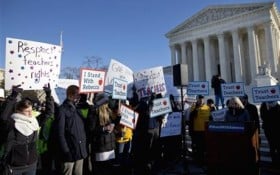
The Supreme Court appears ready to deliver a major setback to American unions as it considers scrapping a four-decade precedent that lets public-sector labor organizations collect fees from workers who decline to join.
During more than an hour of oral arguments Monday, the high court’s conservative justices seemed likely to side with a group of California teachers who say those mandatory fees violate the free-speech rights of workers who disagree with a union’s positions.
Labor officials fear unions’ very existence could be threatened if workers are allowed to get all the benefits of representation without at least paying fees to cover the costs of collective bargaining. The case affects more than 5 million workers in 23 states and Washington, D.C.
But Justice Anthony Kennedy rejected arguments by lawyers for the state of California and the California Teachers Association that the current fee system is needed to prevent non-members from becoming “free riders” — workers who reap the rewards of union bargaining and grievance procedures without paying for it.
“The union basically is making these teachers compelled riders for issues on which they strongly disagree,” Kennedy said, noting the political nature of bargaining issues like teacher salaries, merit promotions and class size.
Even Justice Antonin Scalia, who in the past has expressed some sympathy for the free-rider argument, said all the items negotiated in a collective bargaining agreement “are necessarily political questions.”
Arguing in support of the union, California Solicitor General Edward DuMont said the state needs a reliable bargaining partner that is funded by all the workers it represents. He said the fees for collective bargaining typically apply to non-political issues such as mileage reimbursement, working hours and other mundane matters.
Chief Justice John Roberts dismissed that reasoning, saying even routine matters can become politically charged if they involve how the state spends money. “That’s always a public policy issue,” Roberts said.
The group of 10 teachers that filed the challenge wants the high court to overturn a 1977 case that allows public unions to collect money from members and non-members alike, as long as the funds aren’t spent for political action. The court in that case, Abood v. Detroit Board of Education, said the arrangement was justified to prevent non-members from becoming free riders.
The challengers argue that public-sector unions have become more political over time. They say even a push for higher salaries and pension benefits raises political questions about the best use of tax dollars for cash-strapped localities.
A federal district court ruled against the teachers, saying the outcome was clear under Abood. The 9th U.S. Circuit Court of Appeals affirmed.
Half the states already have right-to-work laws banning mandatory fees, but about 80 percent of workers represented by public-employee unions are in states that don’t, including California, New York and Illinois.
Union advocates say the lawsuit is part of a conservative agenda to weaken unions, which are known for reliably supporting Democratic candidates and policies. The challengers are backed by the conservative Center for Individual Rights.
Arguing for the group of teachers, Michael Carvin said mandatory fees serve to “inflate the union’s war chest by people who really have not made a voluntary decision to do so.”
Some justices were more sympathetic to the unions. Elena Kagan warned that the challengers “come here with a heavy burden” to overturn a nearly 40-year-old case on which thousands of contracts and millions of employees rely.
Justice Stephen Breyer said overturning Abood would require the court to overrule several related cases in which the high court has approved mandatory payments by lawyers to bar associations and mandatory student fees at public universities, calling that “quite a big deal.”
But Carvin said Abood’s rationale is inconsistent with other free-speech cases, noting that the court twice in recent years has issued 5-4 opinions questioning the rationale of that earlier case, though it has stopped short of overruling it.
Arguing for the California Teachers Association, lawyer David Frederick said the First Amendment applies differently to public employees. He said the state has a strong interest in promoting efficiency and avoiding costly workplace disruptions by designating the union as workers’ exclusive bargaining representative.
The Obama administration also weighed in to support the unions. Solicitor General Donald Verrilli told the justices that there has been no change in circumstances over the past 40 years to warrant overturning Abood.
For decades, the growth of union workers in government has helped compensate for steep losses in manufacturing, construction and other private industries where unions once thrived. About half of all members are now in the public sector, which has a membership rate of 36 percent. That’s more than five times the private sector, at 6.6 percent.
Even if the court doesn’t overturn settled precedent, it could still give the challengers a partial victory. The justices are also considering whether public employees should be required to “opt in” to paying the political portion of union dues. Currently, workers must “opt out” of the political fees by checking a box on a form.
The “opt in” requirement could lead to more workers declining to pay the political portion of union dues, though it typically is a much smaller part of the overall payment.
A decision in the case, Friedrichs v. California Teachers Association, 14-915, is expected by late June.
The Associated Press contributed to this article.
Make it class action & involve other union types IE Teamsters & UFCW members too.
Yeah, NO more Unions & games.
NO more Mob rule in the workplace.
“Unions always support the libbys”! That makes them a political action committee, and takes them out of collective bargaining! Unions should not be allowed to support any politician! The members must do it individually! That’s the way Honest People do it anyway!
It’s just that simple
Exactly.
Beck vs. the CWA was about the right of people to opt of union dues. The Supreme Court sent the case back to a lower court for a decision on how much union dues were related to actual bargaining cost. The Supreme Court ruled in favor of the individual employees citing 81 % of the dues collected was use for political purposes. The lower court lowered it to 79 % since the national convention, even though is was a basic waste of money, was a purpose in bargaining a new contract across the country. If you are paying more than 100 a year for dues, you had better find out where your money is going and for what purpose.