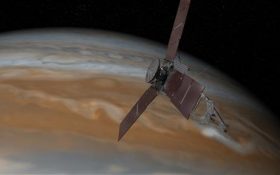
Jupiter takes center stage with the arrival next week of a NASA spacecraft built to peek through its thick, swirling clouds and map the planet from the inside out.
The solar-powered Juno spacecraft is on the final leg of a five-year, 1.8 billion-mile (2.8 billion-kilometer) voyage to the biggest planet in the solar system.
Juno promises to send back the best close-up views as it circles the planet for a year. Jupiter is a gas giant made up mostly of hydrogen and helium unlike rocky Earth and its neighbor Mars. The fifth planet from the sun likely formed first and it could hold clues to how the solar system developed.
A look at the $1.1 billion mission:
THE ARRIVAL
As Juno approaches Jupiter late Monday, it will fire its main rocket engine to slow down and slip into orbit around the planet. This carefully orchestrated move, all preprogrammed, is critical because Juno will zip past Jupiter if it fails to brake. The engine burn — lasting about a half hour — is designed to put Juno on a path that loops over Jupiter’s poles.
Since it takes 48 minutes for radio signals from Jupiter to reach Earth, mission controllers at NASA’s Jet Propulsion Laboratory in Southern California won’t be able to intervene if something goes awry. They’ll watch for beeps from Juno that’ll signal whether the engine burn is going as planned.
“Everything’s riding on it,” Juno chief scientist Scott Bolton said Thursday during a press briefing.
THE MISSION
Spacecraft have visited Jupiter since the 1970s, but there are still plenty of questions left unanswered. How much water does the planet have? Is there a dense core? Why is its signature Great Red Spot — a hurricane-like storm that has been raging for centuries — shrinking?
During the mission, Juno will peer through Jupiter’s dense clouds, flying within 3,100 miles (5,000 kilometers), closer than any other spacecraft.
The goal “is learning about the recipe for how solar systems are made,” said Bolton, who’s from the Southwest Research Institute in Texas.
Earlier visitors included the Voyagers and Pioneers, Galileo, Ulysses, Cassini and most recently, New Horizons, which reached Pluto last year. Most were quick flybys en route to other destinations. Only Galileo — named for the Italian astronomer who discovered Jupiter’s large moons — orbited the massive planet and even released a probe.
THE SPACECRAFT
Named after the cloud-piercing wife of the Roman god Jupiter, Juno carries nine instruments to map Jupiter’s interior and study its turbulent atmosphere. Also stowed aboard are three mini figures of Jupiter, Juno and Galileo designed by the Lego Group. The Italian Space Agency donated a plaque inscribed with Galileo’s writings.
Previous trips to Jupiter have relied on nuclear power because of the distance from the sun. Juno is the first spacecraft to venture this far out on solar power. Juno, about the size of an SUV, has three tractor-trailer-size solar wings that extend outward like blades from a windmill. The solar panels are designed to face the sun during most of the mission.
After its launch on Aug. 5, 2011, Juno took a roundabout journey to Jupiter, swinging around the inner solar system and using Earth as a gravity boost to the outer solar system.
THE PICTURES
The Hubble Space Telescope and other spacecraft have returned stunning pictures of Jupiter, including a new photo released Thursday of its northern lights. But scientists said the best views are yet to come. Juno will get in closer and will provide the most detailed look at the planet’s polar regions, clouds and auroras.
The camera onboard — the JunoCam — has been snapping pictures of Earth, Jupiter and its moons along the way. But the camera and other instruments were turned off this week to avoid any interference during the critical arrival. So there won’t be images at the nail-biting moment when Juno enters orbit around Jupiter.
The public can also vote on where to point the camera. NASA has said pictures from the mission won’t be publicly released until at least late August.
THE FINISH
Once Juno wraps up its work, it will deliberately dive into Jupiter’s atmosphere and burn up. The fiery finale — expected in 2018 — ensures that the spacecraft doesn’t accidentally crash into Jupiter’s moons, particularly the icy moon Europa, a prime target for future missions.
The Associated Press contributed to this article.
I look forward to seeing the discoveries that Juno will make possible. The story mentions Jupiter’s turbulent atmosphere. It will be interesting to see if the turbulence is confined to a certain level of the atmosphere or if it extends to the surface.
Jupiteraians have been hiding under this cloud ever since the observed how screwed up we are here on earth and wanted to conceal their existence so we would not contaminate them with our BS.
Absolutely, Justin, My husband n I have been space fans since 1960’s and the technology today n photography are giving us incredible insight of the intensive physics, mathematics and planning that has home into universes far more magnificent than we ever dreamed possible by our Creator.. To see Hubble photos and special deep space probes sent to planets yet even going beyond expectation has blessed humanity with Gods ” Big art”. Such s thrill to see photo of Pluto with giant perfect heart carved on almost a third of the planet.. We didn’t even expect Pluto to be found or have extra moons or a heart signature.. Who knows what great secrets and beautiful marvels we may get glimpses of from Nupiter.. A truly glorious giant with such variety!!! Space exploration never ceases to amaze !!! Typo Pluto to be round not found, we knew it would likely be found but was always debated to be a large asteroid type asymmetrical ” planet” not round and obviously one and to be at edge of our solar system with giant heart was, to me, like a signature in the corner of a canvas of a fine art oil painting masterpiece. Yet on our solar system, with a signature of sorts.. Ps Hubble just sent photo of new Universe like giant perfect red heart from gases with a green spot in middle where new stars are born… Talk about timing!! Bubble has sent over 10,000 photos so far, very exceptional but this Juno probe is exciting.. Pray it doesn’t bounce off orbit but functions better than imagined!!! Thrilling to find out HOW MUCH, how PERFECT, how SUPERBLY MADE it ALL is!!!
The Giant Red Spot is shrinking because of global warming, and we humans are responsible. We have to do something right now!
Anything we humans could do would have about as much effect on the environment as spitting in the ocean would have on the water level.
Only exception would be a nuclear war, which would throw so much stuff into the air the result would be a nuclear winter.
Wait…that would be global cooling, not global warming.
The heavens declare Gods glory!!