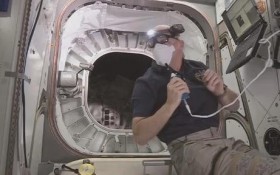
Space station astronauts opened the world’s first inflatable space habitat Monday and floated inside.
NASA astronaut Jeffrey Williams swung open the door to the newly expanded chamber and was the first to enter. He said it was pristine but cold inside.
The room — called the Bigelow Expandable Activity Module, or BEAM — arrived at the International Space Station in April, packed in the trunk of a capsule loaded with supplies. It was inflated just over a week ago.
Mission Control said the temperature registered 44 degrees, as anticipated, at one end of the 13-foot-long, 10 ½ -foot-wide chamber. There was no trace of condensation, Williams noted.
For now, BEAM is empty and dark; Williams and Russian cosmonaut Oleg Skripochka wore head lamps to illuminate the crinkled, silver walls. They collected air samples, took expansion measurements and made sure the air-pressurization tanks were empty, before exiting and closing the door behind them.
The six-man station crew will deploy more sensors and other gear over the next few days. After each brief entry, the hatch will be sealed. Mission Control anticipates just six or seven entries a year.
NASA wants to make certain the multi-layered BEAM — an experiment led by Bigelow Aerospace — can withstand wide temperature fluctuations, radiation and debris impacts over time. It will remain at the orbiting lab for two years.
The Nevada-based Bigelow is developing even bigger and better inflatable habitats for space travel. Until BEAM, the company founded by hotel entrepreneur Robert Bigelow had flown only a pair of inflatable satellites in orbit for testing.
Both Bigelow and NASA envision using pumped-up habitats for Mars expeditions. Inflatable spacecraft are lighter and more compact for launch than the traditional metal housing for astronauts, yet provide roomier living quarters once expanded.
The Associated Press contributed to this article.
I am reminded of the book SevenEves (yeah, it’s a palidrome). by Neal Stephenson.
We’re getting closer to real space colonization. Maybe we’ll have a real base on the Moon or Mars very soon. And much of this exploration is being conducted by private companies. The companies that learn to mine minerals and substances in outer space will be wealthier than can be imagined now. Greed will be a boon to exploration.