When President Trump first unveiled his plan to rebalance U.S. trade with sweeping tariffs and trade deals, stock market analysts literally claimed an “economic armageddon” would take place.
Inflation was set to soar, according to the Fed Chair himself who said on April 16th that Trump’s tariffs were “highly likely” to reignite price increases.
The headlines had a fearmongering field day, with NPR offering tips to “brace for Trump tariffs” including not looking at your retirement portfolio. As a side note, the S&P, a core component of most retirement portfolios, is up 27% since the day following their article, one of the most impressive short-term rallies in U.S. history:
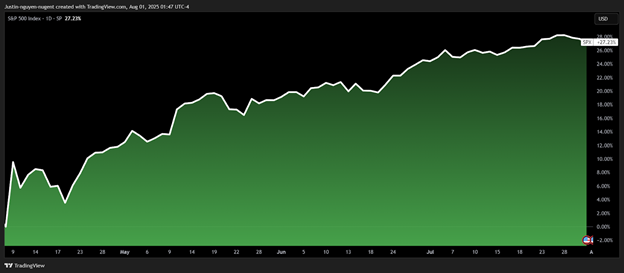
That rally is indicative of the actual impacts we’ve seen from tariffs, which were largely the exact opposite of what was predicted by almost everyone in the mainstream media. That starts with the obvious:
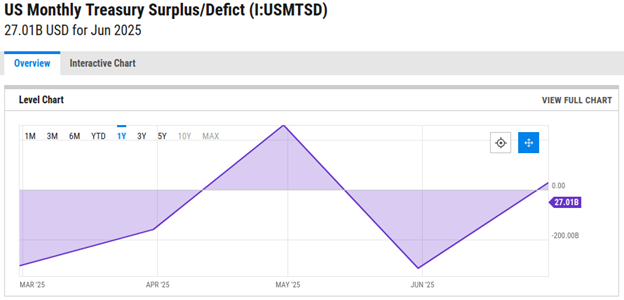
The United States is making money now. During the most recent economic report, the Treasury reported a surprise surplus rather than the expected deficit. It’s the second of the past three months that the U.S. Treasury has reported a monthly surplus.
It goes further: Inflation? It continues to moderate. From April 10th and onward (8 days after Liberation Day), month-over-month CPI (the monthly economic gauge used to measure changes in the prices of goods from shelter to restaurant food to electricity) came in at or below expectations every single month:
| Date | Inflation Read | Expectation | Previous |
| July 15 | 0.3% | 0.3% | 0.1% |
| June 11 | 0.1% | 0.2% | 0.2% |
| May 13 | 0.2% | 0.3% | -0.1% |
| April 10 | -0.1% | 0.1% | 0.2% |
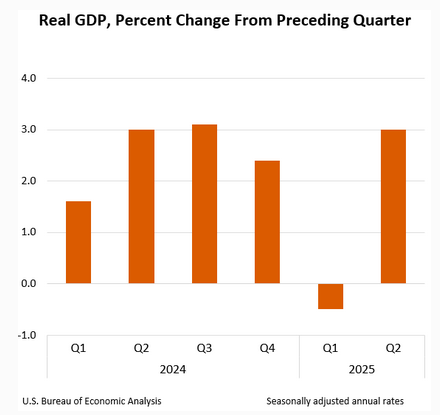
Gross domestic product, a measurement of the total market value of all final goods and services produced within the United States borders, also rose this month:
Pete Najarian, during an appearance on News Nation, explained this perfectly.
The United States holds the cards in trade negotiations – and other countries will do whatever they can to avoid additional tariffs and make trade deals. America is the only store in town – even if they take away the discounts, you still have to stop there. That’s what we’ve seen from April 2nd to today.
Since liberation day, a lot has changed in the tariff landscape, with new changes that came this week. On August 1st, Trump offered a pause to the tariff deadline for Mexico – the same which was offered to China as the countries join in talks to negotiate a trade deal. At the same time, Canada’s tariff was lifted from 25% to 35%. And for the rest of the world, the list is as follows:
| Country/Region | Tariff Rate |
| United Kingdom | 10% |
| Japan | 15% |
| European Union | 15% |
| South Korea | 15% |
| Taiwan | 20% |
| Vietnam | 20% |
| India | 25% |
The rest of the world faces a tiered structure based on trade dynamics:
| Country | Tariff Rate |
| Falkland Islands | 10% |
| Vanuatu | 15% |
| Fiji | 15% |
| Turkey | 15% |
| Iceland | 15% |
| New Zealand | 15% |
| Nigeria | 15% |
| Norway | 15% |
| Afghanistan | 15% |
| Angola | 15% |
| Bolivia | 15% |
| Botswana | 15% |
| Cameroon | 15% |
| Chad | 15% |
| Costa Rica | 15% |
| Côte d’Ivoire | 15% |
| Lesotho | 15% |
| Democratic Republic of the Congo | 15% |
| Ecuador | 15% |
| Equatorial Guinea | 15% |
| Guyana | 15% |
| Israel | 15% |
| Jordan | 15% |
| Ghana | 15% |
| Liechtenstein | 15% |
| Madagascar | 15% |
| Malawi | 15% |
| Mauritius | 15% |
| Mozambique | 15% |
| Namibia | 15% |
| Nauru | 15% |
| North Macedonia | 15% |
| Papua New Guinea | 15% |
| Trinidad and Tobago | 15% |
| Venezuela | 15% |
| Zambia | 15% |
| Zimbabwe | 15% |
| Uganda | 15% |
| Nicaragua | 18% |
| Philippines | 19% |
| Indonesia | 19% |
| Cambodia | 19% |
| Malaysia | 19% |
| Thailand | 19% |
| Pakistan | 19% |
| Sri Lanka | 20% |
| Bangladesh | 20% |
| Brunei | 25% |
| Kazakhstan | 25% |
| Moldova | 25% |
| Tunisia | 25% |
| Algeria | 30% |
| Libya | 30% |
| Bosnia and Herzegovina | 30% |
| South Africa | 30% |
| Iraq | 35% |
| Serbia | 35% |
| Switzerland | 39% |
| Myanmar | 40% |
| Laos | 40% |
| Syria | 41% |
| Brazil | 10% (plus 40% surcharge) |
But even this is not the end of the trade negotiations. Representatives from various countries have spoken out saying that they’ll continue to work with the U.S. to even the trade imbalance. According to sources in Taiwan, the 20% tariff is likely to be temporary, and Taiwan will do whatever it takes to make a deal.
Ultimately, the fearmongers, who profit from sensational headlines forecasting economic doom, have been left red-faced. While they thrive on clickbait, their reluctance to bet against the resilient American stock market speaks volumes. The tariffs have not heralded collapse but rather a revitalized economy, proving that bold leadership can deliver results where timidity fails. As negotiations continue, the U.S. stands poised to secure even greater advantages on the world stage.