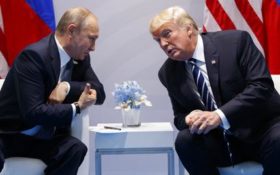

President Donald Trump has dramatically hardened his stance toward Russia after months of unsuccessful negotiations with Russia’s President Vladimir Putin, announcing new weapons shipments to Ukraine and threatening severe economic penalties against Moscow.
The Republican president, who has tried to resolve the war Putin started when he invaded Ukraine three years ago, has seemingly grown tired of his diplomatic overtures being disrespected by Russia.
“I am very disappointed with President Putin. I thought he was somebody that meant what he said — and he’ll talk so beautifully, then he’ll bomb people at night. We don’t like that,” Trump said, marking a sharp departure from his earlier praise of the Russian leader.
.@POTUS: "I am very disappointed with President Putin. I thought he was somebody that meant what he said — and he'll talk so beautifully, then he'll bomb people at night. We don't like that." pic.twitter.com/9HaGgLiKEJ
— Rapid Response 47 (@RapidResponse47) July 14, 2025
Trump announced he would implement “severe tariffs” unless a peace deal is reached within 50 days. The tariffs would be secondary measures targeting Russia’s trading partners in an effort to isolate Moscow in the global economy.
“I use trade for a lot of things,” Trump said. “But it’s great for settling wars.”
The president also revealed that European allies would purchase “billions and billions” of dollars of U.S. military equipment to transfer to Ukraine, replenishing the country’s weapons supplies without further cost to American taxpayers.
The announcement came during an Oval Office meeting with NATO Secretary-General Mark Rutte, where Trump confirmed the plan includes Patriot air defense systems, a top priority for Ukraine as it defends against Russian drones and missiles.
Countries participating in the weapons purchases include Germany, Finland, Canada, Norway, Sweden, the United Kingdom, and Denmark. Rutte said “speed is of the essence here” and said the shipments should make Putin “reconsider” participating in honest peace negotiations.
Trump has expressed growing frustration with Putin since taking office. Initially, the president had expressed a willingness to negotiate with Russia to keep Ukrainian territory it had already captured and said Ukraine’s Crimea region “will stay with Russia.”
Trump told Ukrainian President Volodymyr Zelenskyy in February, “You don’t have the cards right now,” and pressured Ukraine toward making concessions to get a peace deal started.
The president had also pressured Putin and said he believed Putin “wants peace” in Ukraine. However, Russia’s continued escalation of attacks on civilian areas wore down Trump’s patience.
According to the Washington-based Institute for the Study of War, Russian drone and missile strikes on Ukraine have increased following Trump’s January inauguration. June brought the highest monthly civilian casualties of the past three years, with 232 people killed and 1,343 wounded, according to the U.N. human rights mission in Ukraine. Russia launched 10 times more drones and missiles in June than in the same month last year.
“It just keeps going on and on and on,” Trump said. “Every night, people are dying.”
In April, Trump publicly urged Putin to stop the attacks.
“I am not happy with the Russian strikes on KYIV. Not necessary, and very bad timing. Vladimir, STOP!” he warned. By May, Trump posted on social media that Putin “has gone absolutely CRAZY!” as the bombardments continued.
Two rounds of Trump-brokered, indirect ceasefire talks between Ukraine and Russia have produced no results after Russia has refused to budge. After multiple phone calls with Putin since taking office, Trump said he was tired of the lies.
“We get a lot of (expletive) thrown at us by Putin, if you want to know the truth,” Trump told reporters. “He’s very nice to us all the time, but it turns out to be meaningless.”
The Pentagon had briefly paused weapons shipments to Ukraine over concerns that U.S. stockpiles were running low. However, the presidentordered the resumption of weapons shipments and announced the new coordinated effort with NATO allies.
Trump’s special envoy to Ukraine and Russia, retired Lt. Gen. Keith Kellogg, met with Zelenskyy in Kyiv on Monday. Zelenskyy said he had “a productive conversation” with Kellogg about strengthening Ukrainian air defenses, joint arms production, and purchasing U.S. weapons in conjunction with European countries.
“We hope for the leadership of the United States, because it is clear that Moscow will not stop unless its … ambitions are stopped by force,” Zelenskyy said on Telegram.
Germany has already offered to finance two Patriot systems and has given three of its own Patriot systems to Ukraine. German Defense Minister Boris Pistorius was traveling to Washington on Monday to meet with Defense Secretary Pete Hegseth to discuss further cooperation.
“In the coming days, you’ll see weapons flowing at a record level to help Ukraine defend themselves,” Sen. Lindsey Graham, R-S.C., said on CBS’ “Face the Nation.”
“One of the biggest miscalculations Putin has made is to play Trump,” Graham said. “And you just watch, in the coming days and weeks, there’s going to be a massive effort to get Putin to the table.”
In addition, Trump is rallying Congress for bipartisan legislation that would impose severe sanctions on Russia, including a 500% tariff on any country that buys, sells, or supplies Russian oil, gas, and petroleum if Russia refuses to negotiate a peace agreement with Ukraine. Senate Majority Leader John Thune said the bill could be ready for a vote as soon as this month.
“We need a Russia sanctions bill that puts some real constraints on the ability of the president to play on again, off again, with Vladimir Putin,” Sen. Elizabeth Warren said.
“Trump has now figured it out that Putin is the problem,” Former U.S. envoy to Ukraine Bill Taylor said.