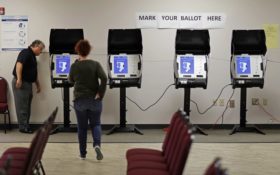
Racing to shore up their election systems before November, states are using millions of dollars from the federal government to tighten cybersecurity, safeguard their voter registration rolls and improve communication between county and state election officers.
The U.S. Election Assistance Commission released a report Tuesday showing how states plan to spend $380 million allocated by Congress last spring to strengthen voting systems amid ongoing threats from Russia and others.
All but a fraction of the money has already been sent to the states, the District of Columbia and U.S. territories. The largest chunk — roughly 36 percent — is being spent to improve cybersecurity in 41 states and territories.
More than a quarter of the money will be used to buy new voting equipment in 33 states and territories, although the bulk of this is unlikely to happen until after the Nov. 6 midterm elections.
States have been scrambling to increase their cyber defenses, upgrade voting systems and provide training to local election officials since it was revealed that Russian hackers targeted election systems in at least 21 states in 2016, although the number is likely greater. There has been no indication any vote tallies were changed.
Meanwhile, the nation’s intelligence chiefs warn of the ongoing threat of Russian interference. On Tuesday, Microsoft said it had uncovered new Russian hacking efforts targeting U.S. political groups.
“This investment comes at a critical point in time,” said commission member Christy McCormick. “We are quickly approaching the November midterm elections, and our election officials are laser-focused on ways to ensure our nation’s elections are secure and accessible.”
A Senate report earlier this year urged states to replace outdated voting equipment and ensure all ballots are cast on machines that produce a paper record allowing voters to verify their selections.
Five states exclusively use touchscreen voting machines that provide no such record, along with more than 300 counties in eight other states, according to Verified Voting, a nonprofit group focused on ensuring the accuracy of elections. One of those states, Georgia, indicated it would use half of its $10.3 million federal grant toward new voting machines, although that amount is just a fraction of what’s needed.
The total cost to ensure a paper trail for all Georgia voters could be as high as $120 million depending on what type of machine the state buys for its 159 counties. The machines will not be in place for the November elections.
New Jersey uses machines similar to those in Georgia, and officials there opted to set aside $2.5 million of its $9.7 million in federal funds to set up a pilot program so local officials can buy or lease voting systems that produce a paper trail. The state has said the program would first operate in small jurisdictions with a small number of voting machines.
A survey earlier this year by the Brennan Center for Justice found that officials in 33 states said they must replace their voting machines by 2020. Many voting systems rely on software and hardware that is no longer supported by manufacturers.
“This is a looming crisis for the United States,” said the center’s Lawrence Norden. “That is true whether we have to worry about the threat of Russians or other nation-states attacking us.”
About $50.7 million, or about 13 percent of the federal total, will be used to improve voter registration systems in 29 states. Russian hackers breached Illinois’ voter registration system in 2016, although officials have said no information was changed or deleted.
Experts remain concerned about the security of those systems, saying hackers could change names, addresses or polling place information and cause confusion, long lines and delays in reporting election results. In turn, such chaos could undermine confidence in the results.
In accepting the federal money, states were required to provide a match of 5 percent and have five years to spend it. Some state officials have urged Congress to create a dedicated funding stream for election security, rather than utilizing a one-time grant program.
“Cybersecurity is a race without a finish line,” said Vermont Secretary of State Jim Condos. “States need ongoing, dedicated maintenance funding to ensure that we have the resources to keep evolving too, to stay one step ahead of those who are attacking our democracy.”
The Associated Press contributed to this article.