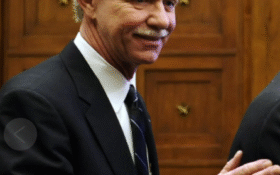

Chesley “Sully” Sullenberger, the retired airline captain who safely landed a US Airways jet in the Hudson River after both engines failed in 2009, announced yesterday that he has been diagnosed with early-stage Alzheimer’s disease.
One of America's greatest aviation heroes is sharing a heartbreaking health update.
Capt. Chesley "Sully" Sullenberger III, the pilot who saved all 155 people aboard US Airways Flight 1549 by safely landing on New York's Hudson River in what became known as the "Miracle on the… pic.twitter.com/VwuXwHaR0N
— Fox News (@FoxNews) July 14, 2026
“I have been diagnosed with Alzheimer’s Disease,” he wrote in a statement.
“It is early stage. For now, this means a name may not come easily to me, I forget a story I have recently told, or I don’t sleep as well, but I am in the beginning of this long journey.”
“It is my hope that by sharing this, other families living in the shadows with this disease will feel they too can step forward,” he said.
“So this new phase of my life has challenged what it means to be of service. And the answer is to speak up.”
Sullenberger, 75, shared with People magazine that he’s had trouble recalling details within the last year, despite having a photographic memory.
He received his official diagnosis in August 2025.
Fox News senior medical analyst Dr. Marc Siegel noted that Sullenberger had been diagnosed with post-traumatic stress disorder (PTSD) after the Miracle on the Hudson, which could have increased his risk.
“Age 75 is relatively late-onset,” Siegel told Fox News.
“PTSD doubles the risk of developing Alzheimer’s because of changing brain chemistry and structure and sleep disruption.”
Sullenberger became known as the “Hero of the Hudson” after safely landing US Airways Flight 1549 in the Hudson River when a bird strike disabled both engines. All 155 people aboard survived.
Sullenberger, a former U.S. Air Force fighter pilot, says he plans to continue serving the public by focusing on raising Alzheimer’s awareness.
“This new phase of my life has challenged what it means to be of service,” he said.
“And the answer is to speak up. It is my hope that by sharing this, other families living in the shadows with this disease will feel they, too, can step forward.”
“So many people told us after Flight 1549, that the outcome gave them hope,” he went on.
“Lorrie, my incredible partner of 37 years, says we can all use a little of that hope right now.”
Sullenberger said his diagnosis “will not prevent me from looking forward to and appreciating our future. I will navigate this chapter with my wonderful family by my side.”
“Over the years, when people would ask about the successful outcome of Flight 1549, I would say that ‘courage can be contagious,’ and on that day it helped everyone band together to get everyone off that airplane successfully,” he said.
“Now we need that courage to battle this disease. I am now part of a larger community with many of you, and we will be courageous together.”
Alzheimer’s, the most common type of dementia, impacts more than seven million people in the U.S. over the age of 65, according to the Alzheimer’s Association.