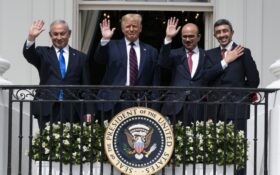

President Donald Trump’s historic Middle East peace deal was clever because it did what no other president had tried before, Rush Limbaugh pointed out Tuesday.
By thinking outside the box, Trump may have just secured lasting peace in the Middle East.
No matter how much someone hates Trump, they must admit that peace in the Middle East is a powerful accomplishment. Even Trump’s political rival, Democratic presidential candidate Joe Biden, praised the deal.
“It is good to see others in the Middle East recognizing Israel and even welcoming it as a partner,” Biden said in a statement on Wednesday. “A Biden-Harris Administration will build on these steps, challenge other nations to keep pace, and work to leverage these growing ties into progress toward a two-state solution and a more stable, peaceful region.”
It’s an achievement that Barack Obama, George W. Bush, Bill Clinton, George H.W. Bush, Ronald Reagan, Jimmy Carter, Gerald Ford, Richard Nixon, Lyndon Johnson, John F. Kennedy, and Dwight Eisenhower all aspired to… but fell short.
What was the secret to Trump’s success?
“The real significance of this is that the Palestinians have sort of been rendered irrelevant in the whole deal. In the past, it was the Palestinians which were the focus, the focal point,” Limbaugh said. “They could stop anything from happening, and they did.”
“So, the thing about it is is that the inside-the-Beltway swamp dwellers have one way of doing things, and they’ve got one way of doing things for peace in the Middle East, for negotiating with communist governments and all that, and none of it, none of it really ever works,” the conservative radio host said. “And that’s just fine with Washington bureaucrats. When there is no solution, then you still have a need for bureaucrats supposedly working very hard for a solution. In many cases, the worst thing that can happen is a solution.”
The Trump administration focused the attention away from Palestine, and put the focus on Iran.
It was that significant change that got the deals done, noted former White House Press Secretary Ari Fleischer.
Another fascinating element of today’s peace deal is the rejection of the previous Administration’s efforts to center the Middle East around Iran. Given a choice between greater Iranian influence or greater Israeli influence, many Arab nations pick Israel. The times are changing.
— Ari Fleischer (@AriFleischer) September 15, 2020
“For decades the experts did the same thing over and over. Every administration tried the same thing … it always involved deference to the Palestinians,” Limbaugh said.
“Trump said, look, these are the people holding it up,” he continued. “They don’t want a deal, so I’m gonna go around ’em. And he did. And in addition to that, he brought in different powers in the Middle East rather than the usual suspects.”
Limbaugh predicted this bold new strategy would bring other U.S. allies to the table and establish lasting peace in the volatile region.
“And, lo and behold, it worked. We now have peace in the Middle East, and it’s just beginning,” Limbaugh said. “United Arab Emirates, Bahrain. You watch. The Saudis are gonna be signatories to this deal before long. Other Arab nations in the Middle East are going to come along with this. Jordan I expect will sign onto this at some point, King Abdullah there.”
Once Israel has been recognized and signed peace deals with other U.S. Arabic allies in the region, Palestine can then be brought into the fold. Then, at long last, one of the world’s most unsolvable problems would finally been resolved.
Peace in the Middle East.
The Horn editorial team