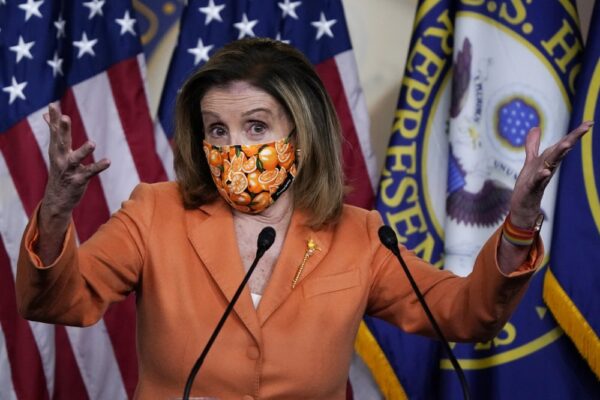
Former House Speaker Nancy Pelosi and the Democratic Party leadership just got devastating news. Quite simply, it’s a polling catastrophe that represents one of the worst approval ratings in modern American political history.
Stunning new Harvard polling data shows the Democratic Party’s support has collapsed across multiple key demographic groups and surveys heading towards the 2026 midterm elections.
The latest Harvard CAPS/Harris Poll shows Democratic Party approval at just 36% in February 2025, the lowest approval rating since March 2018. The bleeding has continued through July 2025, with the party’s approval rating sitting at 40%, down from 42% in June.
The Harvard polling represents just one data point in a broader pattern of Democratic collapse. A CNN poll from March 2025 showed the Democratic Party’s favorability rating at a record low 29% – a devastating 20-point drop since January 2021. NBC News polling found that only 27% of Americans have positive views of the Democratic Party, marking the lowest rating since NBC began tracking this metric in 1990.
The brutal reality is that Pelosi and the Democratic Party leadership are disconnected from American voters — and voters are sick of it.
The party’s leadership crisis extends beyond general approval ratings to specific confidence measures. Gallup polling from April 2025 revealed that confidence in Democratic congressional leadership has hit an all-time low of 25% since the organization began surveying voters on this issue in 2001. This represents a 9-point drop from the previous historic low of 34% set in 2023.
Pelosi, once considered a Democratic powerhouse, has become a symbol of the party’s broader struggles. Gallup polling from January 2025 shows Pelosi with a 33% favorable rating and 56% unfavorable rating, down significantly from 44% favorable in January 2021. Recent YouGov analysis lists Pelosi among politicians with net favorability of -20 or worse, making her one of the most unpopular U.S. political figures in American history.
The Democratic Party’s struggles will almost certainly impact the upcoming election. A recent Quinnipiac poll from June 2025 found that 70% of voters disapprove of Democrats in Congress. The Harvard polling shows that only 27% of Americans approve of how congressional Democrats are performing.
Perhaps most damaging for the party’s future prospects is the internal dissatisfaction among its own supporters. CNN polling found that Democratic-aligned adults say by a 52% to 48% margin that the leadership of the Democratic Party is currently taking the party in the wrong direction. Among Republicans and GOP-leaning independents, 79% viewed their party favorably, while among Democrats and Democrat-leaners, only 63% viewed their own party favorably.
Indeed, the scale of Democratic voter anger is a brutal shift from previous political cycles and threatens to further alienate Independent voters.
A September 2017 poll, at the start of Trump’s first term, found a broad 74% majority of Democrats saying their party should work with Republicans, with just 23% advocating for a more combative approach. Now, frustrated Democratic voters are demanding their leaders take a more extreme, far-Left stance, even as that approach appears to be failing with the broader electorate.
Meanwhile, an overwhelming 71% of overall voters say the Democratic Party needs new moderate figures willing to work with Republicans to lead the party into the 2026 midterms and 2028 election.
“Democrats are doing a good job throwing jabs at the administration but that’s not helping them with their own image, which remains in the cellar,” Mark Penn, chair of the Harris Poll, noted.
The party’s struggles extend into key demographic groups — the so-called “Obama coalition” from the 2008 election. The Harvard poll shows that almost every voter group disapprove of the party. Even among key Democratic constituencies, 34% of surveyed Democratic voters and 43% of surveyed Black voters said they disapprove of the party.
Republican political strategist Jason Roe explained the Democratic collapse to Newsweek.
He said the party’s low approval has “little to do with some newfound affection for Republicans, it is a combination of Democratic failures … Years of focus on bizarre political causes like gender identity, white supremacy, open borders, and utopian climate and economic policies; and feckless leadership that can’t quite figure out how to go after Trump effectively,” Roe said.