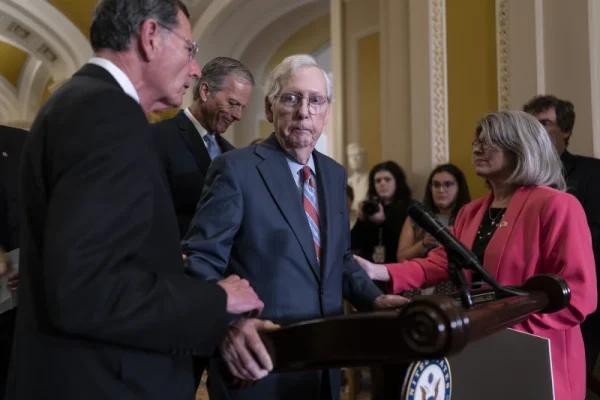
Sen. Mitch McConnell did everything he could to stop the Trump administration’s Department of Government Efficiency (DOGE) spending cuts on Tuesday, joining Democratic Party opposition and forcing Vice President JD Vance to cast a tie-breaking vote in the Senate.
The bill proposes $9.4 billion in federal spending cuts and waste. McConnell, the longtime Republican leader from Kentucky, joined establishment Republican Sens. Susan Collins of Maine and Lisa Murkowski of Alaska and Democrats to try and block the bill from advancing.
Their defection created a 50-50 tie in the Senate Appropriations Committee and nearly sunk the Republican Party package. Vice President Vance broke the tie, allowing the bill to move forward for full Senate debate on Wednesday.
McConnell’s vote came after months of Democratic pressure in Kentucky, where protests called on him to reject the DOGE cuts. In February, the Louisville Democratic Party organized a demonstration called “Marching to Mitch,” where nearly 175 protesters walked from the party headquarters to McConnell’s downtown Louisville office.
“He doesn’t have to really go down in history as someone who just let the country go down this path unchecked,” said Logan Gatti, chair of the Louisville Democratic Party, said at the time. “He can stand up to Donald Trump. He can stand up to Elon Musk and DOGE.”
On Tuesday, McConnell broke with Trump yet again and backed the Kentucky Democrats demands to try to stop the Trump administration.
McConnell defended his choice to join the Democratic Party after forcing the vice president’s tie-breaker, and said Trump did not provide enough details on what spending was being cut.
“They would like a blank check is what they would like, and I don’t think that’s appropriate,” McConnell said about the Trump administration.
“The rescissions package has a big problem — nobody really knows what program reductions are in it,” Sen. Collins said in her own statement. “That isn’t because we haven’t had time to review the bill. Instead, the problem is that OMB has never provided the details that would normally be part of this process.”
McConnell has a record of opposing Trump on key issues. He voted to certify the 2020 election results, rejected Trump’s push to block Ukraine untraceable funding, and was the only Republican senator to oppose many of Trump’s cabinet picks.
Conservatives reacted angrily to McConnell joining with Democrats.
With each vote he casts, Mitch McConnell cements himself as one of the WORST Senators in American history!!
— Madison Cawthorn (@CawthornforNC) July 16, 2025
Three Republicans opposed the bill, all women: Sens Lisa Murkowski, Susan Collins and Mitch McConnell. https://t.co/uRRnAQdpUL
— Ann Coulter (@AnnCoulter) July 16, 2025
The Trump administration had issued an ultimatum to Republicans last week: vote to cut federal spending, or risk losing Trump’s support in their reelection campaigns.
The bill was reduced from $9.4 billion to $9 billion after Senate Republicans negotiated to protect $400 million in PEPFAR funding, a global HIV/AIDS relief program started under President George W. Bush.
The White House sent the Director of the Office of Management and Budget, Russ Vought, to rally Republican senators at a private luncheon on Tuesday.
Senator Mike Rounds of South Dakota later posted on X that he supported the bill after reaching a deal to “find Green New Deal money that could be reallocated to continue grants to tribal radio stations without interruption.”
Senate Majority Leader John Thune defended the spending cuts, saying, “When you’ve got a $36 trillion debt, we have to do something to get spending under control.”
Senator Eric Schmitt of Missouri also backed the package.
“This bill is a first step in a long but necessary fight to put our nation’s fiscal house in order,” Schmitt said.
If the bill passes the Senate later this week, it will return to the House for final approval. It must be signed into law by Friday to prevent spending levels from reverting to former President Joe Biden’s last approved budget.