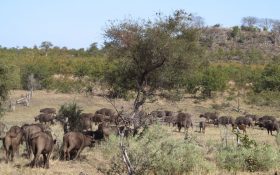
Rangers in South Africa’s biggest wildlife park are killing about 350 hippos and buffalos in an attempt to relieve the impact of the region’s most severe drought in more than three decades.
The numbers of hippos and buffalos in Kruger National Park, about 7,500 and 47,000 respectively, are at their highest level ever, according to the national parks service. Officials plan to distribute meat from the killed animals to poor communities on the park’s perimeter.
The drought has left millions of people across several countries in need of food aid.
Hippos and buffalos consume large amounts of vegetation, and many animals are expected to die anyway because of the drought, said Ike Phaahla, a parks service spokesman. A drought in the early 1990s reduced Kruger park’s buffalo population by more than half to about 14,000, but the population rebounded.
Rangers are targeting hippos in “small natural pools where they have concentrated in unnatural high densities, defecate in the water, making it unusable to other animals,” Phaahla wrote in an email to The Associated Press.
Parks officials have described drought as a natural way of regulating wildlife populations. Earlier this year, they said they didn’t plan any major intervention to try to save wild species in Kruger park, but the drought’s impact intensified. Hippos are in particular trouble because they can’t feed as widely as other animals, returning to water by day after grazing by night.
South Africa’s parks service stopped killing elephants to reduce overpopulation in 1994, partly because of public opposition.
Around 1900, hunting had cleared out elephants in the area that became Kruger park. Today, there are an estimated 20,000 elephants there. Poachers killed 36 elephants this year in the park, raising concerns that the Africa-wide slaughter of elephants for their ivory is finally affecting South Africa.
Poachers have already killed large numbers of rhinos in the park, which borders Zimbabwe and Mozambique and is almost the size of Israel.
Generations ago, an estimated 15,000 people lived in the area that was officially proclaimed as Kruger park in 1926. Some communities were removed from the wildlife reserve under white minority rule at that time.
“These people were pure hunter-gatherers and we greatly underestimate their role in shaping this ecosystem,” Phaahla said. “We have removed this important driver from the Kruger ecosystem and we are researching ways to simulate the return of their role again and the removals or offtakes (of some animals) aim to do just that.”
The Associated Press contributed to this article.
Deplorable, there should be some very harsh punishment for these hunters.
Agreed!
Lorna, you didn’t read the article closely enough. They are thinning the herd to save the majority of the animals. Maybe now is the time for the South African government to earn revenue by selling hunting permits to a few rich big-game hunters?
It seems that ‘man’ isn’t the highest form of life on the earth. Every single time there is a problem (such as Arizona’s wild horses currently being threatened with death), man wants to kill all the animals. God will surely punish those who kill helpless beasts in the name of
‘whatever’!!!! Damn them all!
So why not increase the legal hunting limit or just let nature take it’s course?……I hope they are using the meat from the kills to help feed their population and not sell it to hawkers looking to make a profit…….The poachers must be jumping with joy….
It is not fear real
The authorities shouldn’t kill the innocent beast. The population would be adjusted automatically by the almighty Allah.
Find them and hang them it’s not right
I hope it is really only Hipos and Buffaloes that are affected and that the other animals are still protected.
Some of you people seem to believe that it would be better for these animals to die a slow lingering death from lack of water or food, rather than thin the herds now which means the surviving herds will be stronger and healthier.
Why do you people want these animals to die from lack of food and water ? That is inhumane to allow them to die like that.