by Frank Holmes, reporter
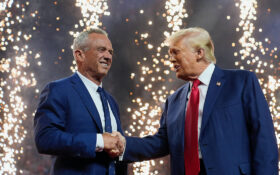
President Donald Trump rode into office 16 months ago with the strong support of a MAGA-MAHA coalition. But all signs show that union is on the verge of falling apart, with each side accusing the other of betrayal.
The Make America Healthy Again (MAHA) movement associated with Robert F. Kennedy Jr. went all-in behind President Trump in 2024, powering him to a clean sweep of every swing state.
Trump appointed RFK Jr. as secretary of Health and Human Services and promised him a relatively free hand.
But MAHA is outraged that President Trump seems to have sided with the manufacturer of a weedkiller that has already paid out billions of dollars in lawsuits for allegedly causing cancer.
“You cannot claim to care about health while protecting poison,” Vani Hari, who posts online under the online handle of “Food Babe,” told the Trump administration at Monday’s “The People vs. Poison” rally. “You cannot tell Americans to eat real food while protecting the cancer-causing chemicals sprayed on it.”
This week, the tension has reached a crescendo.
“I think Trump underestimated the loyalty of the MAHA people, because our loyalty is to our children, not to a party,” said Republican voter Labrada Gore. “The loyalty is really to the people’s health.”
The argument centers around glyphosate, commercially produced under the name Roundup, an inexpensive herbicide farmers spray on their crops and which enters our food supply.
In March, the manufacturer of Roundup, Bayer, proposed a $7.25 billion settlement to class action lawsuits from people who developed non-Hodgkin lymphoma after exposure to the widely used spray. The agreement would settle all current and future claims.
If the deal holds together, Bayer will have paid an incredible $14 billion to handle the medical side effects of Roundup, according to the company’s spokespeople.
MAHA sees evidence the Trump administration is trying to stop huge corporations from paying out huge sums for their actions, even if it means more people get cancer.
Part of the justification for saying glyphosate is safe came from a study the manufacturer knew was fraudulent in 1976—but said nothing.
The official evidence is officially mixed. In 2015, The International Agency for Research on Cancer said it had seen enough proof to declare glyphosate is “probably” a carcinogen for humans. The IARC concluded there is “limited” evidence glyphosate causes cancer in people—and “sufficient” evidence that it’s carcinogenic for animals.
Glyphosate exposure may increase your chance of developing non-Hodgkin lymphoma by 41 percent, researchers at the University of Washington concluded four years later.
Last June, another team of researchers documented “early onset and early mortality for a number of rare malignant cancers, including leukemia, liver, ovary and nervous system tumors” in animals exposed to the herbicide.
It’s not just studies. At Monday’s rally, a farmer emotionally shared how she lost her husband and a pet due to what she believes are the impacts of glyphosate poisoning.
Still, many feds—including some inside of the Trump administration—sides with the weedkiller’s German owners.
Spend 5 minutes and watch this video.
A farmer shares the emotional story of how glyphosate took her husband and dog’s life. #PeopleVsPoisonRally pic.twitter.com/FllVs3bUHl
— Children’s Health Defense (@ChildrensHD) April 27, 2026
The Environmental Protection Agency claims it has seen more data than these limited studies and thinks glyphosate is “not likely” to cause cancer in humans—although the EPA admits the pesticide can induce asthma and other respiratory problems.
MAHA says the EPA is proof of “regulatory capture”: that corporate activists have taken over the federal bureaucracy and used it for their own financial benefit.
The entire government seems to be going to the mat for Monsanto and Bayer, a German-owned company.
The MAHA movement came out in force Monday, as Supreme Court justices heard oral arguments in the case Monsanto Company v. Durnell. Multiple states agree that Roundup isn’t labeled properly for its cancer concerns. But Bayer argued at the Supreme Court that states can’t punish it for not going above-and-beyond federal labeling requirements mandated by the Federal Insecticide, Fungicide and Rodenticide Act (FIFRA). FIFRA trumps the states, and the lawsuits they’ve spawned—so Bayer should go scot-free, company attorneys argued.
Justices will make the call later this year, but the executive branch has already sprung to Bayer’s defense.
President Donald Trump deemed glyphosate and similar herbicides a vital pillar of American national security in a February 18 executive order. He even invoked the Defense Production Act to make sure U.S.-based suppliers produce more of the potentially toxic substances.
And Congress is doing all it can to give the company legal immunity.
Bayer has lobbied hard to get immunity from future websites via multiple bills…and it may have found its silver bullet.
Section 10205 of the farm bill currently pending before Congress would stop states from demanding Roundup state its potential to cause cancer clearly on its label, deferring that call to the federal government.
That was the last straw for a bipartisan coalition of lawmakers, who introduced the No Immunity for Glyphosate Act, which would strip that language out of the bill.
“Bayer has spent over $9 million lobbying for exemption from liability for harm its chemicals, like glyphosate, might cause. To Make America Healthy Again, Congress should remove the language containing the pesticide liability shield from the Farm Bill,” said Rep. Thomas Massie, R-Ky.
“Weakening pesticide oversight moves in the wrong direction,” said Nancy Mace, a member of Congress seeking the Republican nomination for governor of South Carolina. “These provisions preempt state and local authority, shut down judicial review, and hand EPA bureaucrats unchecked power to define what is safe.”
Their proposal is popular. A whopping 97.8 percent of Americans opposed giving legal immunity to glyphosate’s manufacturers in a poll released in March. Admittedly, the poll was commissioned by a MAHA-friendly activist group, the Informed Consent Action Network (ICAN)—but it jibes with an Ipsos/Reuters poll that found 63 percent of respondents said they opposed shielding companie that create cancer-causing products from lawsuits, even if the company warns people of the risk.
Fighting to make sure Monsanto is not accountable for its actions would make President Trump a fresh group of enemies, even within his own coalition.
Democrats are already picking up the political importance of the MAGA-MAHA split. One of Monday’s speakers was Senator Cory Booker, D-N.J., who has all but declared his 2028 presidential candidacy.
But the populist crack-up could pave the way for the most interesting presidential candidate of 2028 by far: Robert F. Kennedy Jr.
🚨 EXCLUSIVE: Rep. Thomas Massie Sounds the Alarm on Glyphosate Immunity 🚨
Our own @CaraCastronuova interviewed @RepThomasMassie – and what he revealed should have every American paying attention.
A foreign corporation (German giant Bayer/Monsanto) is ATTACKING Americans on… pic.twitter.com/gFz2nvDx9i
— LindellTV (@RealLindellTV) April 27, 2026
The Horn told you last November of reports that Robert F. Kennedy Jr. is considering running for president in 2028. The third party he formed in 2024, the We The People Party, came out of retirement last September with plans to nominate a presidential candidate in two years’ time.
Kennedy addressed the issue last August in a social media post saying only that he is not currently “running for president in 2028” and promising to stand with President Trump until the second term ends. That leaves the door open.
And his estranged cousin, Jake Schlossberg, has already given up the game.
“He’s going to run” for president in 2028, said Schlossberg. “Definitely.”
Kennedy usually ranks in single digits for the 2028 Republican presidential nomination—way behind front-runner J.D. Vance.
But 2028 is a political eternity away.
RFK Jr. consistently ranked as the most likeable candidate in 2024.
And no one said Kennedy will run as a Republican.
Will President Trump, the master of the art of the deal, strike a bargain to keep MAHA part of his MAGA coalition during the rest of his second term?
Will MAHA heed RFK Jr.’s advice to eliminate glyphosate incrementally and work within the administration?
Or will MAHA activists hold grudge and decide they could make more progress against multinational corporations by siding with congressional Democrats than standing by a lame duck president?