
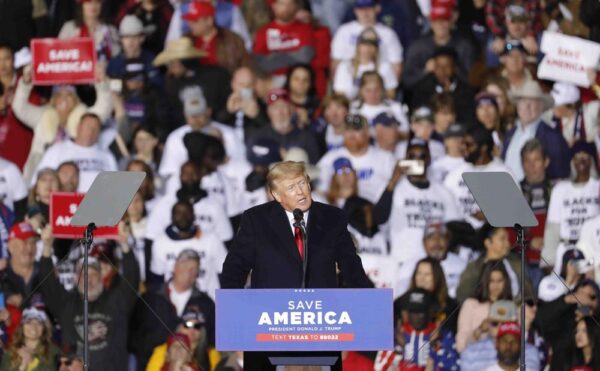
Former President Donald Trump has narrowed down his list of potential vice presidential candidates to just a few candidates.
The former president indicated that he has made his final decision and that his running mate will be present at Thursday’s first election debate against President Joe Biden in Atlanta.
With the Republican National Convention on the horizon, speculation is mounting about who it is that is joining Trump on the ticket. The choice carries significant weight, as Trump’s running mate could become the frontrunner for the 2028 Republican presidential nomination if Trump were to win a second term.
Trump has stated that his primary consideration for a vice president is their ability to serve as commander in chief. However, other factors are undoubtedly at play. The chosen candidate must be able to raise donor funds, perform well on television, hold their own in debates against Vice President Kamala Harris, and possess what Trump considers “the look.”
Additionally, Trump is reportedly wary of choosing someone who could overshadow him or spark early discussions about 2028.
While Trump’s campaign has cautioned against speculation, stating that only Trump himself knows the final decision, several names have emerged as strong contenders.
The remaining potential candidates are:
Doug Burgum: The North Dakota governor has rapidly become one of Trump’s most visible defenders since ending his own presidential bid. Burgum’s wealth, stemming from his successful software company, aligns with Trump’s preference for successful associates.
At 67, Burgum presents a safe choice reminiscent of Mike Pence – a relatively low-profile governor unlikely to steal the spotlight.
His personal rapport with Trump and his wife is said to be strong, a factor that carries significant weight in Trump’s inner circle.
J.D. Vance: The 39-year-old senator from Ohio has transformed from a Trump critic to one of his fiercest defenders. Vance’s youth could inject energy into the campaign, and his media savvy could prove valuable.
However, his past criticisms of Trump, including calling him “America’s Hitler,” may be a hurdle to overcome.
Marco Rubio: The Florida senator could help expand the ticket’s appeal to more moderate Republicans and Hispanic voters. Rubio’s foreign policy expertise and debate skills are assets, but his residency in Florida poses a constitutional challenge that would require him to change his official residence.
The question remains whether Rubio truly wants the position as Trump’s second fiddle, given his notably lower public profile in the VP race.
Tim Scott: As the only Black Republican in the Senate, Scott would bring racial diversity to the ticket. His preacher-like speaking style and frequent use of Scripture could resonate with religious voters.
Scott’s recent endorsement of Trump and enthusiastic campaigning on his behalf have not gone unnoticed, with Trump praising Scott’s performance as a surrogate.
Elise Stefanik: The New York congresswoman is the only woman left on Trump’s shortlist. Once an aide to Trump critics, Stefanik has transformed into a loyal Trump supporter.
Her aggressive questioning of university presidents over antisemitism raised her profile significantly. Stefanik could potentially help Trump win over college-educated and suburban women voters who sided with Biden in 2020.
Ben Carson: The former neurosurgeon and Housing and Urban Development Secretary has developed a strong bond with Trump over the years.
At 72, Carson is unlikely to overshadow Trump and could help appeal to minority voters. However, his history of controversial comments on various issues could prove problematic.
Byron Donalds: The Florida congressman has become one of Trump’s most prominent Black supporters and a reliable surrogate. At 45, Donalds represents a fresh face that could appeal to younger Black voters. Like Rubio, he would likely need to change his residency to join the ticket.
As the selection process continues, Trump’s penchant for headline-stealing drama mean that surprises are still possible.
The stakes are high for Trump’s vice presidential pick. The chosen candidate will need to demonstrate unwavering loyalty, a quality Trump found lacking in his previous vice president, Mike Pence, during the tumultuous aftermath of the 2020 election.
Pence’s refusal to support Trump’s challenge to the election results has led to a rift, with Pence declining to endorse Trump in the current race.
As the Republican National Convention approaches, all eyes will be on Trump’s announcement this week. The chosen running mate will not only play a crucial role in the 2024 campaign but could also shape the future of the Republican Party — and America — for years to come.
With each potential candidate bringing unique strengths and potential challenges to the ticket, Trump’s final decision will be a defining moment in the lead-up to what promises to be a fiercely contested election.