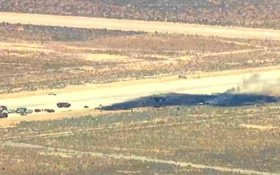
A B-52 bomber crashed shortly after takeoff at a U.S. Air Force base in Southern California’s Mojave Desert and burst into flames Monday, killing all eight people aboard, military officials said.
Aerial footage showed virtually nothing left of the aircraft that went down around 11:20 a.m. during a routine test mission at Edwards Air Force Base, which is north of Los Angeles. Black smoke rose from a large swath of charred desert near the runway on the base, with emergency vehicles nearby.
Those on the B-52 included government contractors and uniformed military. Aircraft manufacturer Boeing confirmed Monday evening that two of its employees were on board.
After reviewing footage of the crash, it was determined that no one could have survived, Col. James Hayes, the deputy commander for the 412 test wing at Edwards, said at a news conference.
“We lost eight great Americans,” Hayes said, adding that officials were working to notify their families.
It was not immediately clear what caused the crash, and it could take up to six months to complete an investigation, Hayes said, but shared that the B-52 was supporting the “radar modernization program.”
The Boeing B-52 Stratofortress is a long-range bomber that entered service in 1955. Designed to carry both conventional and nuclear weapons, it has been used in conflicts involving the U.S. military from Vietnam to Iran.
In 2025, Boeing sent a B-52 to Edwards with a new, modernized radar system. A test team planned to conduct ground and flight test activities on the aircraft throughout 2026 to feed a production decision, the air force said in a 2025 news release. The modern Active Electronically Scanned Array (AESA) radar system replaced the aircraft’s antiquated radar for efficacy. It was unclear if that was the same aircraft involved in Monday’s crash.
Edwards Air Force Base is home to a large portion of the U.S. Air Force’s aircraft test and development efforts and is about 100 miles north of Los Angeles. The 412th Test Wing, which runs the base, also conducts developmental testing of all Air Force aircraft, weapons systems, software and components before purchase by the service as well as throughout their lifespan.
The vast desert base is where Air Force test pilot Chuck Yeager reached a speed of Mach 1.05 and broke the sound barrier in 1947.
The airfield was closed most of Monday and all inbound aircraft were being diverted, but it reopened to people coming onto the base by late afternoon. Non-commercial visitor passes for the base were suspended as emergency crews doused the flames.
It’s too soon to say what might have happened.
Air Force Secretary Troy Meink said he is deeply saddened by the lives lost.
“We mourn this loss and honor the service of our Airmen, civilians, and contractors who work every day to advance our mission,” he said in a post on X.
The way the B-52 crashed so quickly after takeoff without getting very high or going far makes aviation safety expert Jeff Guzzetti suspect some kind of flight control malfunction.
It’s possible the controls were rigged wrong after maintenance, he said, or a catastrophic engine problem or a failure of a piece of equipment that was being tested.
“I think it was definitely a controllability issue. Now, whether that was tied to an engine failure, a flight control failure, or some new testing device failure, I’m not sure,” said Guzzetti, who used to investigate crashes for both the Federal Aviation Administration and the National Transportation Safety Board.
Although the Air Force has been flying B-52 bombers for more than 70 years, testing out new equipment on a plane can create new challenges.
“A flight test is always riskier than normal operations, so that’s why you have specially trained test pilots, and you should have other safety protocols,” Guzzetti said.
In recent years, fatal Air Force training accidents in the U.S. have included an instructor pilot who was killed in 2024 when the ejection seat activated while the aircraft was still on the ground in Texas and an Air Force ROTC cadet’s death in a 2022 accident involving a Humvee during a training exercise in Idaho. Two Air Force pilots were killed when a trainer jet crashed near an Alabama airport in 2021.
The Associated Press contributed to this article