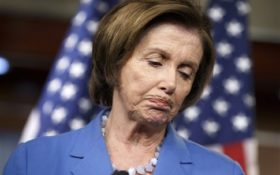

Since announcing her retirement from Congress, former House Speaker Nancy Pelosi’s cushy, lavish finances have come back into the spotlight.
Multiple reports have surfaced since she announced she will not seek reelection in 2026 that her net worth skyrocketed to an estimated $280 million since she first took office four decades ago.
Pelosi and her husband Paul have raked in more than $130 million in stock profits over the course of her congressional career, according to The New York Post.
That represents a return of 16,930% since she walked into office.
And while Pelosi’s retirement may be on easy street, news broke that there’s one multimillion dollar payday she may NOT be getting.
There have been renewed calls amongst bipartisan leaders to reexamine annual pension benefits paid out to outgoing congressional leaders that cost taxpayers some $38 million per year to payout.
Pelosi is one of a record number of congressional lawmakers who announced they will not seek re-election next year, which reportedly kickstarts a little-known payout for ex-lawmakers.
Under federal law called the Federal Employees Retirement System (FERS), members of Congress qualify for annual pension benefits only after completing five full years of service.
Pelosi’s estimated pension figure – given the pay bump she received as House speaker and her election to the House before reforms made the system less generous – will be “one of the most substantial” on record for any current or former member of Congress in FERS, said Demian Brady, the vice president of research for the National Taxpayer Union Foundation.
The longtime California Democrat will benefit from an estimated $107,860 per year upon retirement in 2027, according to FERS data.
The most recent publicly available data shows retirement benefits for former members of Congress totaled more than $38 million in 2022, according to Congressional Research Services.
The average annual annuity received under FERS was $45,276.
A separate pension plan under the Civil Service Retirement System (CSRS) – which is closed to lawmakers who began service after 1984 – paid out an average $84,504 to 261 enrollees in 2022.
Rep. Thomas Massie (R-Ky.), has been one of the biggest proponents for eliminating congressional pensions – but he doesn’t blame anyone for accepting the benefits.
“Senators can opt out of paying into FERS but Representatives may not,” Massie told The New York Post.
“If a member is required to pay into the program, they should be able to receive it.”
Massie said he plans to “reintroduce soon” legislation to end the eligibility of House lawmakers in the FERS program, as well as a separate bill that would “make participation optional for Representatives.”
“If congressmen want to save for retirement, they should do so with 401(k)-type plans, rather than rely on taxpayers to take care of them even after leaving Congress,” he said.
“To tackle out-of-control federal spending, Congress must lead by example by ending defined-benefit pensions for Members of Congress.”
Florida Republican Gov. Ron DeSantis, a former congressman, publicly pledged in 2013 that he would not accept his pension benefits despite paying into the system and authored the legislation Massie (an original co-sponsor) intends to put forward once again.
“I didn’t run for Congress for the perks,” DeSantis said at the time.
“I ran for office to be the type of citizen legislator our Founding Fathers envisioned and to change the prevailing culture in Washington.”
Pelosi is one of the wealthiest members of Congress and one of the best-known investors on Capitol Hill.
In the last three years, her disclosed trades had a volume of about $59 million, according to data from Capitol Trades, which tracks lawmakers from both parties.
Conservative commentator Scott Jennings recently joked that “President Trump should hire Nancy Pelosi in retirement to manage Americans’ stock market portfolios … We could all be retired in 6 months!”
The Pelosi’s portfolio includes major holdings in Apple, Amazon, Nvidia, Microsoft, Alphabet, and other technology companies that have benefited from laws coming out of Congress.
Paul Pelosi handles investments for the Pelosi family through his firm, Financial Leasing Services Inc.