The U.S. Border Patrol is monitoring millions of American drivers nationwide in a program intended to identify illegal immigrants whose travel patterns it deems suspicious.
The predictive intelligence program has resulted in people being stopped, searched, and in the cases they’re illegal immigrants, arrested. A network of cameras scans and records vehicle license plate information, and an algorithm flags vehicles deemed suspicious based on where they came from, where they were going, and which route they took. Federal agents in turn may then flag local law enforcement.
Suddenly, drivers find themselves pulled over — often for reasons cited such as speeding, failure to signal, the wrong window tint or even a dangling air freshener blocking the view.
Once limited to policing the nation’s boundaries, the Border Patrol has built a surveillance system stretching into the country’s interior that can monitor drivers daily actions and connections for anomalies instead of simply targeting wanted suspects. Started about a decade ago to fight illegal border-related activities and the trafficking of both drugs and people, it has expanded over the past five years.
The Border Patrol has recently grown even more powerful through collaborations with other agencies, drawing information from license plate readers nationwide run by the Drug Enforcement Administration, private companies and, increasingly, local law enforcement programs funded through federal grants. Texas law enforcement agencies have asked Border Patrol to use facial recognition to identify drivers, documents show.
Under the Trump administration’s heightened immigration enforcement efforts, CBP is now poised to get more than $2.7 billion to build out border surveillance systems such as the license plate reader program by layering in artificial intelligence and other emerging technologies.
The result is a mass surveillance network with a particularly American focus: cars.
The Border Patrol has for years hidden details of its license plate reader program, trying to keep any mention of the program out of court documents and police reports, former officials say, even going so far as to propose dropping charges rather than risk revealing any details about the placement and use of their covert license plate readers. Readers are often disguised along highways in traffic safety equipment like drums and barrels.
The Border Patrol has defined its own criteria for which drivers’ behavior should be deemed suspicious or tied to drug or human trafficking, stopping people for anything from driving on backcountry roads, being in a rental car or making short trips to the border region. The agency’s network of cameras now extends along the southern border in Texas, Arizona and California, and also monitors drivers traveling near the U.S.-Canada border.
And it reaches far into the interior, impacting residents of big metropolitan areas and people driving to and from large cities such as Chicago and Detroit, as well as from Los Angeles, San Antonio, and Houston to and from the Mexican border region.
Border Patrol’s parent agency, U.S. Customs and Border Protection, said they use license plate readers to help identify threats and disrupt criminal networks and are “governed by a stringent, multi-layered policy framework, as well as federal law and constitutional protections, to ensure the technology is applied responsibly and for clearly defined security purposes.”
“For national security reasons, we do not detail the specific operational applications,” the agency said. While the U.S. Border Patrol primarily operates within 100 miles of the border, it is legally allowed “to operate anywhere in the United States,” the agency added.
While collecting license plates from cars on public roads has generally been upheld by courts, some legal scholars see the growth of large digital surveillance networks such as Border Patrol’s as raising constitutional questions. Courts have started to recognize that “large-scale surveillance technology that’s capturing everyone and everywhere at every time” might be unconstitutional under the Fourth Amendment, which protects people from unreasonable searches, said Andrew Ferguson, a law professor at George Washington University.
Today, predictive surveillance is embedded into America’s roadways. Mass surveillance techniques are also used in a range of other countries, from authoritarian governments such as China to, increasingly, democracies in the U.K. and Europe in the name of national security and public safety.
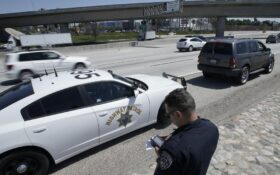
Border Patrol agents and local police have many names for these kinds of stops: “whisper,” “intel” or “wall” stops. Those stops are meant to conceal — or wall off — that the true reason for the stop is a tip from federal agents sitting miles away, watching data feeds showing who’s traveling on America’s roads and predicting who is “suspicious,” according to documents and people interviewed by the Associated Press.
The Associated Press contributed to this report.