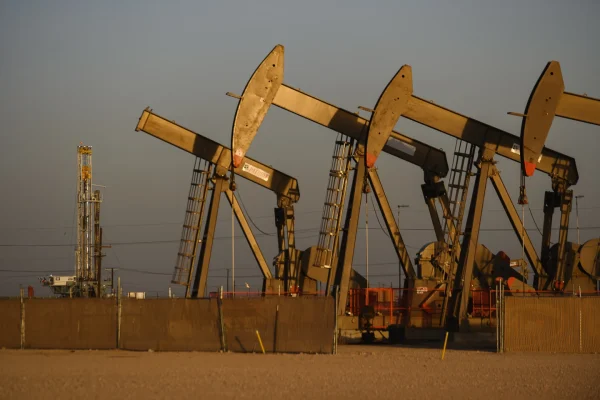
Drill, baby, drill! American oil production has shattered records, cementing the United States as the world’s energy superpower for the seventh straight year.
U.S. crude oil production hit 13.4 million barrels per day in August 2024, according to data from the U.S. Energy Information Administration. The figure is a new monthly record, surpassing the previous high of 13.3 million barrels per day set in December 2023.
Production has continued climbing throughout 2025. June saw output reach 13.58 million barrels per day, the highest monthly figure ever recorded in American history. The EIA projects production will average 13.5 million barrels per day for all of 2025, with the potential to hit 13.6 million barrels per day by December.
The numbers represent a remarkable achievement for American energy. Before the shale revolution, U.S. oil production peaked at 9.6 million barrels per day in 1970 and fell to just 5 million barrels per day in 2008. Hydraulic fracturing and horizontal drilling reversed that decline, turning the United States into a global energy giant.
A Department of Energy spokesperson credited the Trump administration for the surge.
“Thanks to President Trump’s leadership, the United States is more energy dominant than ever – as shown by the record U.S. crude oil production achieved earlier this year and the EIA’s short term projections of even higher all-time production by December 2025,” the spokesperson said. “While long-term forecasts are often revised, the reality is evident – America is leading the way in energy production by cutting red tape and unleashing affordable, abundant, and reliable global supply of oil and gasoline, delivering on the President’s promise to put the American people first.”
The Permian Basin in West Texas and southeastern New Mexico has driven much of the growth. The basin now accounts for roughly 40% of all U.S. crude oil production, making it one of the largest oil-producing regions in the world. Texas alone produced 5.86 million barrels per day in October 2024, a state record.
Ten counties in the Permian Basin account for 93% of U.S. oil production growth since 2020. Crude oil production in those ten counties averaged 4.8 million barrels per day in 2024, representing 37% of the U.S. total.
Texas continues to lead the nation in energy output. The state’s crude oil production represents 44% of the national total. Texas natural gas marketed production accounted for nearly 30% of national production last year.
Todd Staples, president of the Texas Oil and Gas Association, praised the industry’s performance.
“Remarkably, 2024 was yet another record-breaking year as the Texas oil and natural gas industry does its part to help reach Governor Abbott’s goal for our state’s economy to surpass France as the 7th largest economy in the world,” Staples said. “From tax revenues and production to pipelines, storage, processing, refining, and exports, Texas’ oil and natural gas industry has achieved record-breaking performance across every sector.”
The industry has achieved the production gains with fewer drilling rigs than in previous years. The active rig count for major producing regions declined 18% from the January 2023 high, yet production has continued to climb. Companies have leveraged technological advances including artificial intelligence, electronic hydraulic fracturing technologies, and automated drilling processes to optimize operations.
Annual U.S. field production of crude oil averaged 13.235 million barrels per day in 2024, the highest figure in records dating back to 1859. Prior to 2024, annual U.S. field production had never averaged 13 million barrels per day or more.
The United States has outpaced Russia and Saudi Arabia every year since 2018. Russia produced 10 million barrels per day in 2023, while Saudi Arabia produced 9.7 million barrels per day. Together, the top three oil producing nations pumped 32.8 million barrels per day in 2023, delivering roughly 40% of global oil production.
The surge in production has positioned the United States as a major energy exporter. The Netherlands is the top buyer of American crude, which is then distributed into the European Union. South Korea is the second-largest buyer.
Natural gas production has followed a similar trajectory. The United States became a net natural gas exporter for the first time since 1957 during Trump’s first term. Natural gas exports set an annual record for the tenth year in a row in 2024, with volumes more than twice the level of imports.
The Texas oil and gas industry paid a record $27.3 billion in taxes and royalties in fiscal 2024, the most ever in state history and greater than the tax revenue of 34 states.
Pipeline infrastructure has expanded to support the record production. Texas pipeline infrastructure grew to 465,025 miles, an increase of 13,000 miles from 2022-2023, according to the Texas Railroad Commission.
The EIA expects well productivity to continue increasing in 2025, pushing production to new heights. The recent addition of the Matterhorn Express pipeline in the Permian region provides additional capacity for natural gas, allowing producers to increase crude oil production in areas where gas takeaway had been a constraint.
American energy dominance shows no signs of slowing down.