
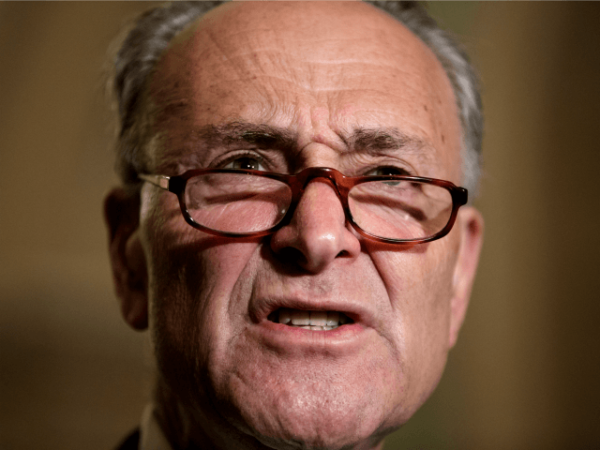
Senate Majority Leader John Thune will invoke the so-called “nuclear option” as early as Monday to break Senate Minority Leader Chuck Schumer’s unprecedented blockade of President Donald Trump’s nominees.
The move will end seven months of obstruction Schumer has used to prevent the administration from filling key government positions.
It’s an unwelcome return from the weekend for Schumer. Thune will reform Senate rules allowing simultaneous confirmation of lower-level executive branch nominees in groups rather than forcing individual votes on each candidate. The rule change could grant swift confirmation votes to more than 100 civilian nominees who have been blocked before the Senate’s scheduled September 19 recess.
Trump has become the first president on record to not have a single nominee confirmed via voice vote or unanimous consent. Schumer told The Wall Street Journal in February he would urge his caucus to vote “no” on every single Trump nominee, and Democrats have largely followed through by holding up every executive branch nominee since then.
“We have never seen a time where the opposition party has literally blocked and forced the president and his team and us here as the majority in the Senate to go through all the machinations of trying to get a nominee across the finish line,” Thune said.
“So this is of the Democrats’ making,” Thune explained. “There isn’t anything right now that they want to vote for that he has his fingerprints on, and getting his team in place is absolutely essential. It’s part of governing this country, and we’re going to move forward.”
Schumer’s tactics have been a hypocritical break from his own stated principles. In 2022, when then-President Joe Biden already had 405 Senate-confirmed nominees in place, Schumer argued for swift confirmations.
“For decades, Democrats and Republicans have regularly cooperated to swiftly confirm the many, many individuals selected by each president to serve in their administration,” Schumer said. “Regardless of the party in the White House, both sides have long agreed that a president deserves to have his or her administration in place, quickly.”
“That doesn’t mean we don’t disagree. But it does mean when nominees are held up, opposed, or blocked—it’s for a legitimate purpose, not for leverage in partisan games, to score political points at the expense of public safety,” Schumer said at the time.
Trump had 65 percent of his civilian nominees confirmed via voice vote or unanimous consent in his first term. Biden had 57 percent confirmed through the same process. But Secretary of State Marco Rubio has been the only Trump nominee in this term not subjected to a filibuster.
Thune organized a working group in August after negotiations with Democrats to clear the backlog collapsed. The group included Republican Senators Katie Britt of Alabama, James Lankford of Oklahoma, Ron Johnson of Wisconsin, Eric Schmitt of Missouri, and Ted Budd of North Carolina.
The working group developed a plan based on a 2023 proposal from Democratic Minnesota Senator Amy Klobuchar that would have permitted up to ten nominees who cleared the same committee to be confirmed at once. The Republican reform will likely be more expansive by removing caps on the number of nominees confirmed simultaneously.
The proposed rules change will exempt judges and Cabinet nominees from the group confirmation process.
Senator Britt highlighted the unprecedented nature of the current situation in a post on X Wednesday.
“By the end of the 119th Congress (on January 2, 2027), the Senate is on track to confirm just 426 nominees, the fewest in history, and less than half of what other Presidents have averaged since 2000,” Britt wrote.
She warned that the pace would only get worse as the backlog grows.
“Fast forward to 2028. If the Senate keeps up this record pace of voting, President Trump will have just 872 nominees confirmed—the first time in history any President will have less than 1,000,” Britt posted. “In the same time period: Biden – 1,175 confirmed, Trump 1 – 1,233 confirmed.”
Under current Democratic procedural roadblocks, the Senate would need to hold 600 additional roll call votes to clear the existing backlog. That number does not account for hundreds of additional executive branch nominees requiring Senate confirmation that have yet to clear their respective committees.
Thune warned that continued obstruction at the current pace would leave hundreds of vacancies remaining by the time Trump’s term ends.
“Democrats have made President Donald Trump the first president on record to not have a single nominee confirmed via voice vote or unanimous consent, and they are forcing time-consuming votes on noncontroversial nominees who go on to be confirmed by large bipartisan margins,” Thune wrote. “It’s Trump Derangement Syndrome on steroids.”
“It’s delay for delay’s sake, and it’s a pettiness that leaves desks sitting empty in agencies across the federal government and robs our duly elected president of a team to enact the agenda that the American people voted for in November,” he added.
Thune emphasized that Trump received a mandate from voters in the past election — one that Schumer and Democrats are blocking. He finally took steps Monday to fight back.
“President Trump and Republicans received a mandate from the American people in November. It is far past time that the president’s nominees receive confirmation votes from the Senate – and this Senate Republican majority will take steps this week to make it happen,” Thune declared.