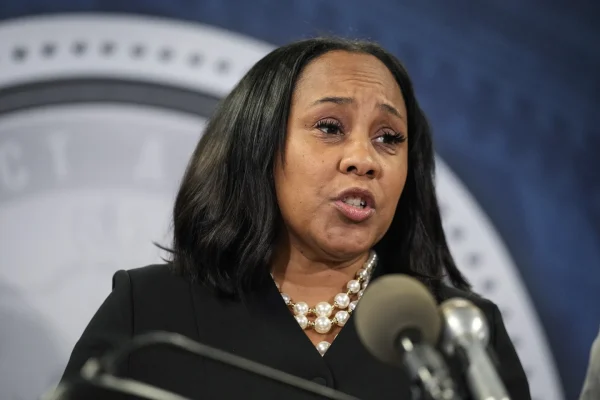
Fulton County District Attorney Fani Willis is facing mounting legal troubles — and now she can’t hire anyone to help her office.
Multiple courts have ordered Willis to pay tens of thousands in attorney fees and turn over records she previously claimed did not exist, while her office struggles with staffing shortages and major funding issues.
It’s bad news across the board for Willis, who made a national name for herself when she prosecuted President Donald Trump.
A Georgia state court ordered Willis to conduct new searches for Trump-related records and provide additional information on Monday after finding that her office failed to search the devices of key personnel, including former Special Prosecutor Nathan Wade, her former lover. The court gave Willis 14 days to submit search protocols and clarify whether Wade’s materials were searched at all.
The latest court order stems from a Judicial Watch lawsuit filed after Willis falsely denied having any records responsive to requests for communications with Special Counsel Jack Smith’s office and the January 6 Committee. Willis’s office eventually admitted to finding 212 pages of records after what was believed to be a fifth search of her office.
“Fani Willis can’t be trusted,” said Judicial Watch President Tom Fitton. “Every time we go back to court there are new excuses and new documents that she said never existed. And now we find that entire universes of records may have been ignored.”
The court criticized Willis’s office for its “desultory efforts to determine the full universe of responsive information” and noted the “repeated denials of their existence” regarding records that were eventually found. The court awarded Judicial Watch $21,578 in attorney fees and costs, which Willis paid 10 days after the court-ordered deadline.
In a separate case earlier this year, Fulton County Superior Court Judge Rachel Krause ordered Willis to pay over $54,000 in attorney fees to lawyer Ashleigh Merchant and turn over documents within 30 days after finding that Willis’s office violated Georgia’s Open Records Act. Judge Krause found that the failures to comply with records law “were intentional, not done in good faith, and were substantially groundless and vexatious.”
The court determined that Willis’s office was “openly hostile” to Merchant, who represents former Trump campaign staffer Michael Roman, and that her requests “were handled differently than other requests.”
Open records officer Dexter Bond refused to communicate by phone with Merchant despite this being his standard practice with other requesters, which the judge said “indicates a lack of good faith.”
Willis and her office “lacked substantial justification” for not complying with the records requests, according to Judge Krause’s ruling.
Meanwhile, Willis is struggling to staff her office amid funding disputes with Fulton County commissioners.
Willis posted on LinkedIn seeking assistant district attorneys, writing, “We’re hiring Assistant District Attorneys! If you’re a passionate prosecutor ready to serve the people of Fulton County with integrity and excellence, we want to hear from you.”
Willis accused multiple Fulton County commissioners of lying during an interview over a funding dispute that she claims has created a backlog of cases, leaving over 100 people in the Fulton County jail for over 90 days without formal indictment. Willis requested a $7 million budget increase but received far less.
The financial arrangements with Wade have also come under scrutiny. Wade reportedly earned $250 per hour while working on the Trump case, compared to $200 per hour for RICO expert John Floyd. Willis received campaign donations from Wade’s business partners during her 2020 campaign, then awarded tens of thousands of dollars in contracts to his firm.
Willis denied wrongdoing in 2024, accusing her critics of “playing the race card” while falsely claiming she paid outside prosecutors involved in the Trump case the same rate.
The Trump election interference case originated from a grand jury indictment in August 2023 that charged Trump and 18 others under Georgia’s anti-racketeering law. The alleged scheme included Trump’s call to Georgia Secretary of State Brad Raffensperger urging him to help find enough votes to beat then-President-elect Joe Biden. Four people ended up pleading guilty while Trump and others, including Roman, pleaded not guilty.
The multiple court orders and legal setbacks represent a dramatic fall for Willis, who rose to national prominence for taking on Trump but now faces numerous, very serious legal questions herself.