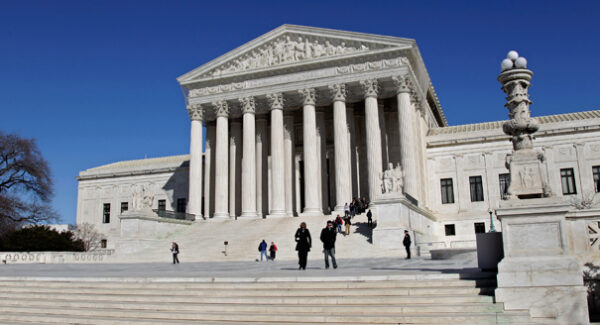
The Supreme Court delivered a significant victories to President Donald Trump’s administration on Friday, starting with a 6-3 decision that limits federal judges’ power to issue nationwide injunctions to stop Trump’s birthright citizenship executive order.
SCOTUS also delayed a ruling on Louisiana’s congressional redistricting until next term.
In the birthright citizenship case, the conservative majority sided with the Trump administration’s request to narrow nationwide injunctions so they apply only to states, groups, and individuals that sued, rather than blocking policies across the entire country.
“When a court concludes that the executive branch has acted unlawfully, the answer is not for the court to exceed its power, too,” Justice Amy Coney Barrett wrote for the majority. However, she indicated the injunctions are limited “only to the extent that the injunctions are broader than necessary.”
Trump celebrated the ruling during a White House briefing, calling it an “amazing decision, one that we’re very happy about.”
The court “delivered a monumental victory for the Constitution, the separation of powers and the rule of law, in striking down the excessive use of nationwide injunctions to interfere with the normal functioning of the executive branch.”
The case arose from Trump’s executive order attempting to end automatic birthright citizenship for children born to parents in the U.S. illegally or on temporary visas. In response, three federal district court judges had issued universal injunctions barring the administration from enforcing Trump’s policy anywhere in the country.
Justice Ketanji Brown Jackson wrote a dissent, accusing her conservative colleagues of creating “an existential threat to the rule of law” by allowing Trump to “violate the Constitution.”
She warned that “executive lawlessness will flourish” if lower-court judges are now required to let a president “act unlawfully.”
“Eventually, executive power will become completely uncontainable, and our beloved constitutional Republic will be no more,” Jackson wrote.
Liberal Justice Sonia Sotomayor read a summary of her dissent from the bench, calling the ruling a “travesty for the rule of the law [and an] open invitation to bypass the constitution.”
The court’s opinion said Trump’s birthright citizenship order can’t take effect for 30 days from Friday’s ruling, giving more time for legal challenges.
Trump said the ruling means “a whole list” of his administration’s policies can now move forward.
“Thanks to this decision, we can now probably file to proceed with these numerous policies and those that have been wrongly enjoined on a nationwide basis, including birthright citizenship, ending sanctuary city funding, suspending refugee resettlement, freezing unnecessary funding, stopping federal taxpayers from paying for transgender surgeries and numerous other priorities of the American people.”
In a separate major development, the Supreme Court delayed a decision on Louisiana’s congressional districts until its next term, announcing it wanted more information and the case would be reargued starting in October.
The order came over the dissent of Justice Clarence Thomas, extending the years-long battle over redistricting in Louisiana to at least this fall. The dispute centers on whether Louisiana’s second congressional map, drawn to include a second Black-majority district to comply with the Voting Rights Act, violates the Constitution’s prohibition on racial gerrymandering.
“I respectfully dissent from the Court’s decision to set these consolidated cases for reargument. Congress requires this Court to exercise jurisdiction over constitutional challenges to congressional redistricting, and we accordingly have an obligation to resolve such challenges promptly,” Thomas wrote.
Louisiana Attorney General Liz Murrill said they welcome the ruling as a chance to present further arguments.
“Although we hoped for a decision this Term, we welcome a further opportunity to present argument to the Court regarding the States’ impossible task of complying with the Court’s voting precedents,” Murril said.
The current map was passed in 2024 after state lawmakers added a second majority-minority congressional district in response to a lower court ruling that found Louisiana’s Black population was too large for the state to legally have just one majority-minority district.
A group of non-Black voters challenged the 2024 map, arguing that the legislature leaned too heavily on race to create the new district. State lawmakers had effectively chosen to cut through the district previously represented by Garrett Graves, a white Republican, to create the new district won by Black Democrat Cleo Fields in November 2024.
The Supreme Court also let stand government programs that reduce broadband internet and telephone service costs for poor and rural communities, rejecting a conservative group’s argument that Congress violated separation-of-powers principles in setting up the program.
Attorney General Pam Bondi said the administration was “very confident” the Supreme Court would eventually rule in its favor on the merits of Trump’s birthright citizenship executive order.