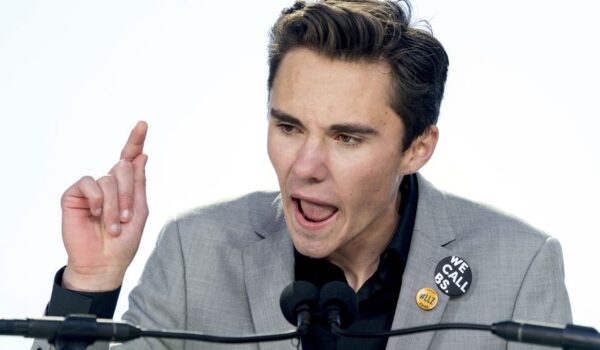
Far-left activist and Democratic leader David Hogg was ousted as Democratic National Committee vice chair after party members voted overwhelmingly Wednesday to vacate his position and that of Malcolm Kenyatta over apparent DEI violations, ending months of internal party warfare sparked by his $20 million campaign against incumbent Democrats.
Seventy-five percent of the 393 participating DNC members voted to uphold a resolution calling for new elections for both vice chair positions, while 25% voted against the measure. Hogg announced he won’t run for re-election.
The decision followed a complaint by longtime Democratic Party activist Kalyn Free, who alleged the February elections violated party DEI provisions and parliamentary procedure.
“I came into this role to play a positive role in creating the change our party needs,” the 25-year-old progressive activist said in a statement to the New York Times. “It is clear that there is a fundamental disagreement about the role of a Vice Chair — and it’s okay to have disagreements. What isn’t okay is allowing this to remain our focus when there is so much more we need to be focused on.”
“Ultimately, I have decided to not run in this upcoming election so the party can focus on what really matters. I need to do this work with Leaders We Deserve, and it is going to remain my number one mission to build the strongest party possible.”
The controversy erupted after Hogg announced in April that his organization Leaders We Deserve would spend $20 million trying to oust older Democratic incumbents in safely blue districts he described as “asleep at the wheel.” The group this week endorsed 37-year-old Virginia state Del. Irene Shin in the special election to replace the late Rep. Gerry Connolly.
DNC Chair Ken Martin had given Hogg an ultimatum to either rescind his vice chair position or abandon his political activities through his PAC, warning that party neutrality in primaries was essential. The tensions boiled over in a leaked May 15 Zoom call where Martin expressed frustration with Hogg’s impact on party operations.
“No one knows who the hell I am, right? I’m trying to get my sea legs underneath of me and actually develop any amount of credibility so I can go out there and raise the money and do the job I need to put ourselves in a position to win,” Martin told Hogg during the call. “I don’t think you intended this, but you essentially destroyed any chance I have to show the leadership that I need to. So it’s really frustrating.”
The complaint centered on how the DNC conducted its February officer elections. Because party rules have clear DEI requirements on equal gender representation on the executive committee, the DNC needed to elect at least one man to the final two vice chair slots. Instead of holding separate votes for each position, the party held a single vote to decide both slots, which Free argued violated charter provisions and “discriminated against three women of color candidates.”
“This was never about Malcolm Kenyatta or David Hogg,” Free told Fox News. “For me, this was about ensuring that the Democratic Party lives up to our ideals as the only political party to believe in and stand up for election integrity and a free and fair democracy.”
However, Hogg framed the ouster differently, and said there were clear political motivations behind the DEI complaint.
“While this vote was based on how the DNC conducted its officers’ elections, which I had nothing to do with, it is also impossible to ignore the broader context of my work to reform the party which loomed large over this vote,” Hogg said after the Credentials Committee elevated Free’s complaint.
Hogg accused Martin of “trying to change the rules because I’m not currently breaking them” when the neutrality pledge was proposed.
Kenyatta, who received the most votes during the February election, criticized Hogg for playing “fast and loose with the facts without rebuttal” and disputed narratives that centered the controversy around Hogg personally.
“Any story about this that neatly places this into a narrative about David Hogg is wrong,” Kenyatta said. “I worked my a– off to get this role and have done the job every day since I’ve held it. This story is complex, and I’m frustrated — but it’s not about @davidhogg111. Even though he clearly wants it to be.”
With Hogg’s withdrawal from the re-election, Kenyatta becomes the only male candidate for the position that must be filled by a man under party rules. The DNC will conduct new elections from June 12-17, with only candidates who were eligible for the third ballot during the February election qualifying to run: Kenyatta, Free, Jeanna Repass, and Shasti Conrad.
“The DNC will immediately move to administer new ballots for the final two Vice Chair positions, one of which must be held by a male and one of which may be held by a candidate of any gender,” said DNC Deputy Press Secretary Nina Raneses. “The election for the male Vice Chair position will commence tomorrow morning at 10:00AM ET.”
Critics noted the dysfunction and chaos within the Democratic Party that the controversy revealed to the public.
“This is Olympic-level DNC’ing. You can’t DNC any harder than this,” Data analyst Nate Silver said.
Hogg also posted a lengthy thread on X explaining his decision and criticizing aspects of the Democratic Party, but deleted it shortly after posting. The Parkland school shooting survivor had been brought into party leadership as part of an effort to broaden the Democratic base and appeal to younger voters, particularly young men.