
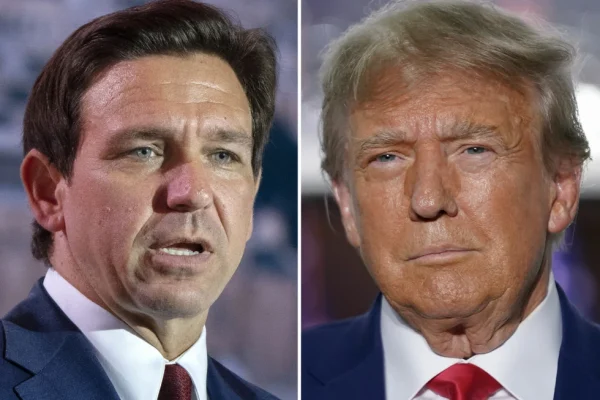
Florida Governor Ron DeSantis voiced rare criticism of President Donald Trump’s ongoing nuclear negotiations with Iran, calling the diplomatic efforts “hazardous” and expressing skepticism about the Iranian regime’s trustworthiness.
During an interview with conservative radio host Mark Levin, DeSantis warned against “trying to cut a deal with Iran” and argued that Tehran cannot be treated as a traditional negotiating partner.
“I don’t see them as being good faith actors and in any way, shape or form. And the reality is they cannot be allowed to enrich uranium, period. End of story,” DeSantis said.
The Florida governor emphasized the fundamental differences between Iran’s theocratic leadership and other nuclear powers, particularly regarding their willingness to engage in nuclear conflict.
“They are a militant Islamic government. Their view of mutual destruction with nuclear weapons is actually something they think would be fine because they think they’re all going to go to heaven in paradise if that happens,” DeSantis stated.
DeSantis contrasted Iran’s leadership with the Soviet Union during the Cold War, arguing that unlike Soviet leaders who believed nuclear war was “not very appealing,” Iran’s leaders could view a nuclear exchange with Israel as “doing the will of Allah.”
The criticism comes as Trump pursues a diplomatic solution to stop Iran’s nuclear program. Earlier this year, Trump sent a message to Iran’s Supreme Leader Ali Khamenei expressing his desire to see a nuclear deal resolved “very soon.”
Trump’s approach represents a shift from his first-term policy when he withdrew the United States from the Joint Comprehensive Plan of Action in 2018. The JCPOA was a highly controversial nuclear agreement negotiated under the Obama administration that Trump abandoned during his previous presidency.
The president’s diplomatic efforts have created tension with Israel, which strongly opposes allowing Iran to develop any kind of nuclear capabilities. Trump confirmed Wednesday that he warned Israeli Prime Minister Benjamin Netanyahu against attacking Iran during the current negotiations.
“I told [Benjamin Netanyahu] this would be very inappropriate to do right now because we’re very close to a solution,” Trump told reporters, confirming reports that he pressured the Israeli leader to refrain from military strikes.
During Trump’s recent three-country swing through the Middle East, leaders of Saudi Arabia, Qatar, and the United Arab Emirates all expressed opposition to attacking Iran’s nuclear facilities. The Arab leaders were concerned their countries would face Iranian retaliation, partly because they host U.S. military bases.
Director of National Intelligence Tulsi Gabbard provided a different assessment of Iran’s nuclear status during testimony to the Senate Intelligence Committee in March. She told lawmakers that Iran “is not building a nuclear weapon and Supreme Leader [Ayatollah Ali] Khamenei has not authorized the nuclear weapons program that he suspended in 2003.”
Despite this intelligence assessment, concerns remain about Iran’s nuclear capabilities and intentions. Experts fear that if Iran obtains nuclear weapons, it could spark a nuclear arms race throughout the Middle East region.
Trump has not entirely ruled out the possibility of a military response if Iran develops nuclear weapons, though he currently appears focused on diplomatic solutions.
DeSantis, who has long been a staunch defender of Israel, also emphasized the historical and religious connections between Israel and Western civilization during his radio interview.
“You could trace back the history of Western civilization all the way back to the ancient state of Israel and the birth of both Judaism and Christianity, and we wouldn’t have the United States of America if it didn’t trace back to that,” the Florida governor said.
In addition to concerns about Iran’s nuclear program, the United States has been alarmed by Iran’s funding of terrorist activities throughout the Middle East region.
DeSantis argued that Iran’s status as “not a traditional country” means it cannot be approached through conventional diplomatic methods that might work with other nations.