Senate Republicans are preparing to tear apart President Donald Trump’s massive spending package he dubbed the “Big, Beautiful Bill” after it narrowly squeaked through the House early Thursday, with fiscal conservatives and establishment Republicans demanding different sweeping changes that could derail the entire effort.
Conservatives have blasted the bill as grossly irresponsible, as it cuts tax revenue for the government while not doing enough to slash the spiraling federal deficit — and would balloon the already out-of-control debt level of the United States.
Establishment figures say any cuts to spending are too much.
The huge 1,116-page bill faces opposition from multiple Republican factions despite Trump’s lobbying efforts, setting up a bruising deficit fight.
Sen. Rand Paul of Kentucky immediately declared his opposition Thursday, vowing to vote against the bill unless leaders remove the $4 trillion debt ceiling increase.
“We’ve never, ever voted to raise the debt ceiling this much. It’ll be a historic increase. I think it’s not good for conservatives to be on the record supporting a $4 trillion or $5 trillion increase in the debt ceiling,” Paul said. “The anticipated deficits per year now will be $2 trillion a year for the next two years. It’s not conservative; I can’t support it.”
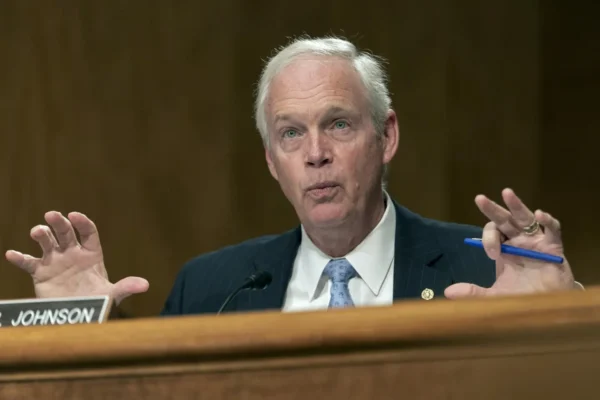
Sen. Ron Johnson of Wisconsin, another fiscal hawk, claimed he has enough Republican allies to block the bill entirely if changes aren’t made to slash spending.
“I think I’ve got at least four right now that this is not going anywhere. Three in addition to myself. We’ve got the four we need,” Johnson said Thursday.
Johnson dismissed any pressure tactics from Trump, noting that senators face different political dynamics than House members.
“Listen, in the House, President Trump can threaten to primary [holdouts], and those guys want to keep their seats. I understand the pressure. Can’t pressure me that way.”
The Wisconsin senator wants to establish a process for finding $6.5 trillion in cuts over the next decade, pointing out that the current approach to U.S. deficit levels a disaster waiting to happen.
“I’m hoping now we’ll actually start looking at reality. I know everybody wants to go to Disney World, but we just can’t afford it,” Johnson said.
Senate Majority Leader John Thune can only afford to lose three Republican votes to pass the legislation through reconciliation, making the conservative opposition particularly dangerous for the massive spending bill.
Beyond fiscal hawks, a separate group of establishment Republicans is balking at the bill’s much needed Medicaid reforms, which would impose work requirements and change federal funding formulas. Sens. Josh Hawley, Susan Collins, Lisa Murkowski, and Jerry Moran have all expressed concerns about impacts on their states.
“These are working people in particular who are going to have to pay more,” Hawley said about proposed cost-sharing requirements for adults earning between 100 and 138 percent of the federal poverty level.
Collins worried about effects on rural hospitals in Maine, saying “We’re still trying to figure out what the provider tax reforms are but I’m very worried about our rural hospitals.”
Trump reportedly told House Republicans to “don’t f**k around with Medicaid” during negotiations, despite Medicaid spending making up a huge part of the U.S. federal debt — dwarfing the size of the small Department of Government Efficiency cuts in recent months.
Another major flashpoint involves the elimination of green energy tax credits from the Biden-era Inflation Reduction Act. Sens. Thom Tillis, John Curtis, Murkowski, and Moran wrote to Thune warning against “full-scale repeal” that could strand billions in private investment.
“If millions or billions of dollars have been deployed, we’ve got to give those businesses some offramp,” Tillis said Thursday, comparing sudden subsidy cuts to Biden’s cancellation of the Keystone XL pipeline.
The SALT deduction increase negotiated by Speaker Mike Johnson to win over moderate New York Republicans is also drawing fire from Senate conservatives. The House bill raises the state and local tax deduction cap from $10,000 to $40,000 for incomes under $500,000.
“The SALT thing is going to come up. It’s going to be an issue,” Sen. Mike Lee said, reflecting broader Republican skepticism about subsidizing high-tax blue states.
The Congressional Budget Office projects the bill will add yet another $3.8 trillion to federal deficits over the next decade, though Johnson estimates the real figure could reach $4 trillion when accounting for likely extensions of temporary tax breaks.
Thune has set a July 4th deadline for Senate passage but acknowledged the timeline depends on “what does it take to get to 51” votes. He said Trump called him after the House vote and is “very happy” and “ready to go to work with the Senate.”
However, Thune faces demands from different Republican factions, with fiscal hawks demanding actual, meaningful spending cuts while moderates seek to preserve popular spending programs and tax breaks.
If Senate Republicans force major changes, the bill must return to the House for another vote before reaching Trump’s desk, extending the legislative battle well beyond the July 4th target.