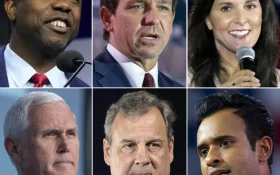
The stage is set for the first Republican presidential debate of the 2024 campaign, with the Republican National Committee saying late Monday that eight candidates had met the qualifications to be on stage in Milwaukee.
To qualify for the Aug. 23 debate, candidates needed to satisfy polling and donor requirements set by the RNC: at least 1% in three high-quality national polls or a mix of national and early-state polls, between July 1 and Aug. 21, and a minimum of 40,000 donors, with 200 in 20 or more states.
To appear onstage, candidates needed to commit at least 48 hours before the Wednesday evening debate, according to RNC criteria, which also required participants to sign a pledge promising to support the party’s eventual nominee.
A look at who’s in, who’s out and who’s decided not to participate:
RON DESANTIS
The Florida governor has long been seen as former President Donald Trump’s top rival, finishing a distant second to him in polls in early-voting states and in national polls as well, and raising an impressive amount of money.
But DeSantis’ campaign has struggled in recent weeks to live up to high expectations. He let go of more than one-third of his staff as federal filings showed his campaign was burning through cash at an unsustainable rate.
With Trump absent, DeSantis may be the primary target for others on stage. According to people familiar with DeSantis’ planning who were granted anonymity to discuss strategy, the campaign is preparing him for nonstop attacks.
DeSantis has been participating in debate-related question and answer sessions at least once a week, having brought in experienced debate strategist Brett O’Donnell to assist.
TIM SCOTT
The South Carolina senator has been looking for a breakout moment. The first debate could be his chance.
A prolific fundraiser, Scott entered the summer with $21 million cash on hand.
In one debate-approved poll in Iowa, Scott joined Trump and DeSantis in reaching double digits. The senator has focused much of his campaign resources on the leadoff GOP voting state, which has a large number of white evangelical voters.
Scott is hitting the early-state campaign trail after the debate, traveling to New Hampshire, Iowa and his home state of South Carolina, where he has four stops planned on Monday.
NIKKI HALEY
She has blitzed early-voting states with campaign events, walking crowds through her successes ousting a longtime South Carolina lawmaker, then becoming the state’s first female and first minority governor. Also serving as Trump’s U.N. ambassador for about two years, Haley frequently cites her international experience, focusing on the threat China poses to the United States.
The only woman in the GOP race, Haley has said transgender students competing in sports is “the women’s issue of our time” and has drawn praise from a leading anti-abortion group, which called her “uniquely gifted at communicating from a pro-life woman’s perspective.”
Entering the race in February, Haley has brought in $15.6 million. Making no mention of plans to go on the attack while speaking to reporters in Iowa earlier this month, Haley did explain why she showed up to the state fair in a shirt that read, “Underestimate me, that’ll be fun.”
VIVEK RAMASWAMY
The biotech entrepreneur and author of “Woke, Inc.: Inside Corporate America’s Social Justice Scam” is an audience favorite at multi-candidate events and has polled well despite not being nationally known when he entered the race.
Ramaswamy’s campaign says he met the donor threshold earlier this year, but this summer he rolled out “Vivek’s Kitchen Cabinet” to boost his donor numbers even more by letting fundraisers keep 10% of what they bring in for his campaign.
As he pursues a whirlwind campaign schedule, Ramaswamy has done virtually no formal debate prep, according to a senior adviser granted anonymity to discuss campaign strategy. The adviser said he’ll spend the day before the debate playing tennis and spending time with family.
CHRIS CHRISTIE
The former New Jersey governor opened his campaign by portraying himself as the only candidate ready to take on Trump. Christie called on the former president to “show up at the debates and defend his record,” calling him “a coward” if he doesn’t.
Last month, Christie — who kicked off his campaign in June — told CNN that he surpassed “40,000 unique donors in just 35 days.” He also has met the polling requirements.
DOUG BURGUM
Burgum, a wealthy former software entrepreneur now in his second term as North Dakota’s governor, has been using his fortune to boost his campaign.
He announced a program last month to give away $20 gift cards — “Biden Relief Cards,” hitting President Joe Biden’s handling of the economy — to as many as 50,000 people in exchange for $1 donations. Critics have questioned whether the offer violates campaign finance law.
Within about a week of launching that effort, Burgum announced he had surpassed the donor threshold. Ad blitzes in the early-voting states helped him meet the polling requirements.
MIKE PENCE
Trump’s vice president had met the polling threshold but struggled to amass a sufficient number of donors, raising the possibility he might not qualify for the first debate.
But on Aug. 8, Pence’s campaign announced that it had crossed the 40,000 donor threshold, and also that he had become the first candidate to formally submit his donor count to the RNC for verification.
An adviser who spoke on the condition of anonymity to discuss internal strategy said earlier this month that Pence had participated in roughly a half-dozen formal debate prep sessions to date, including at least one in which a campaign aide previously close to Trump is playing the part of the former president.
ASA HUTCHINSON
The former two-term Arkansas governor was the final candidate to meet the RNC’s qualifications. Satisfying the polling requirements but slowly working on passing the donor threshold, Hutchinson said Sunday on CNN that he had finally surpassed 40,000 unique donors.
Hutchinson is running in the mold of an old-school Republican and has differentiated himself from many of his GOP rivals in his willingness to criticize Trump. He posted pleas on Twitter for $1 donations to help secure his slot.
The Associated Press contributed to this article.