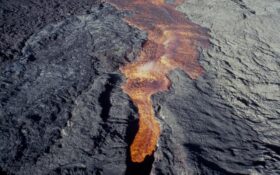
Authorities in Iceland on Tuesday warned tourists and other spectators to stay away from a newly erupting volcano that is spewing lava and noxious gases from a fissure in the country’s southwest.
The eruption began Monday afternoon after thousands of earthquakes in the area, meteorological authorities said. This one comes 11 months after its last eruption officially ended. The eruption is in an uninhabited valley near the Litli-Hrútur mountain, some 30 kilometers (19 miles) southwest of the capital, Reykjavik.
The area, known broadly as Fagradalsfjall volcano, erupted in 2021 and 2022 without causing damage or disruptions to flights, despite being near Keflavik Airport, Iceland’s international air traffic hub. The airport remained open on Tuesday.
The Icelandic Meteorological Office said the eruption was initially more explosive than the previous two. Aerial footage showed streams of orange molten lava and clouds of gases spewing from a snaking fissure about 900 meters (half a mile) long.
“Gas pollution is high around the eruption and dangerous,” the Met Office said. “Travelers are advised not to enter the area until responders have had a chance to evaluate conditions.”
By Tuesday morning, the fissure and the volume of the eruption had shrunk, scientists said.
“This has become a small eruption, which is very good news,” University of Iceland geophysics professor Magnús Tumi Guðmundsson told national broadcaster RUV.
He said the eruption could “certainly last a long time, but luckily we’re not looking at a continuation of what we saw in the first few hours.”
A 2021 eruption in the same area produced spectacular lava flows for several months. Hundreds of thousands of people flocked to see the sight.
Iceland, which sits above a volcanic hot spot in the North Atlantic, averages an eruption every four to five years.
The most disruptive in recent times was the 2010 eruption of the Eyjafjallajokull volcano, which sent huge clouds of ash into the atmosphere and led to widespread airspace closures over Europe. More than 100,000 flights were grounded, stranding millions of international travelers and halting air travel for days because of concerns the ash could damage jet engines.
The Associated Press contributed to this article.