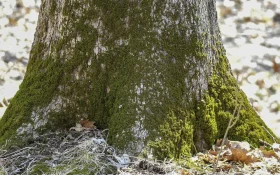
Now that deciduous trees are bare, trunks and branches have taken center stage, and you might be noticing nuances and irregularities that evaded your attention over the summer. For instance, what are those green masses growing on your trees?
Those growths could be either lichens, moss or algae, and the good news is that none are cause for alarm.
Because they usually grow on stressed or declining trees, many people assume these organisms are responsible for making their trees sick. But they aren’t parasitic; they’re opportunistic, which is to say they like to grow on trees that are already ailing or growing in poor conditions.
Lichens are symbiotic organisms of fungi, algae and possibly yeast that live off each other, not your tree. They typically present as pale green or gray (or sometimes orange) crusty or leafy masses on tree branches and trunks, rotting logs and wood fences.
The growth of lichens is actually a good sign because they will not survive in polluted areas. If you’ve got lichens, you’ve got good air quality.
However, because lichens often take advantage of already stressed trees, their presence typically indicates the need for a bit of TLC. Water the trees, aerate the soil around them, and apply much to the root zone, which is the area that begins 4 inches (10 centimeters) away from the trunk and extends as far as the branches reach overhead.
Moss is another non-parasitic organism that thrives in moist conditions and grows on trees, lawns or even bare soil in shady areas. Growing in green or yellow mats or tufts, moss prefers low soil fertility, acidic pH levels and compacted soil. In most cases, moss growth is harmless. But if the growth is excessive, its waterlogged weight can threaten to damage branches.
To discourage moss growth on a tree, prune branches in the center of the canopy to allow more light and air to circulate within it.
If you find the moss unsightly or fear it may weigh down a branch, you can gently scrape it off or apply a copper fungicide, following label instructions.
Algae, usually considered an aquatic plant, can also grow on trees, walkways, roofs, fences and houses, thriving in moist or shady areas. The green or orange film can easily be power washed or scrubbed off inorganic surfaces and should be removed when it creates dangerous conditions, such as a slippery walkway. Adding 1/8 cup of chlorine bleach or white vinegar to a gallon of water and applying that solution to algae will slow its regrowth. Just take care to avoid contact with plants.
It isn’t necessary to remove algae from trees. But if it bothers you, spray affected areas with 1 teaspoon of copper sulfate diluted in 8 gallons of water.
However, if you don’t correct the shady conditions, inadequate drainage and/or low soil fertility in the area, the algae will likely return.
The Associated Press contributed to this article.