Hong Kong reopened beaches and pools and relaxed other pandemic restrictions Thursday, a day after China’s capital, Beijing, announced it would ease its tough quarantine rules for arrivals from overseas.
The two Chinese cities are at opposite ends of COVID-19 outbreaks. Hong Kong is emerging from by far its deadliest wave, which killed 9,000 people. In Beijing, a new wave is just beginning and authorities have imposed a series of restrictions on residents to try to snuff it out.
The easing of quarantine requirements was a reminder that China does want eventually to back off from its strict “zero-COVID” approach that is imposing growing economic and human costs, though officials have shown no inclination to do so in a meaningful way anytime soon.
In Hong Kong, the rising costs have sparked a backlash against “zero COVID.” The city closed water sports venues during its outbreak of the highly transmissible omicron variant, but has been reducing restrictions as cases decline. Deaths from COVID-19 have fallen from a high of almost 300 per day in March to zero in recent days.
Restaurants are also allowed to seat up to eight customers per table — up from four previously — and masks will no longer be required during outdoor exercise, a change that’s important to organizers of group sporting events.
“We’re looking forward to Mother’s Day, and being able to have up to eight people sitting at a table,” said William So, assistant general manager of the London Restaurant, a long-time destination for traditional dim sum.
“Business will go up, three generations of a family can sit down and eat together,” said So, as carts piled high with steaming bamboo baskets of savory dumplings circulated through the packed dining room. Already, bookings have more than doubled since the relaxed seating policy was announced, he said.
A further round of easing is scheduled to begin May 19, when bars and clubs will be allowed to reopen and restaurants in the southern Chinese city will be permitted to serve customers until midnight.
China has maintained its hard-line “zero-COVID” approach but has imposed less onerous restrictions in Beijing than in other cities such as Shanghai, where millions were placed under strict lockdown.
Beijing will now require arrivals from overseas to quarantine at a hotel for 10 days, followed by another week of home isolation.
Previous rules required 21 days of isolation, at least 14 of them at a hotel, followed by seven days of regular health reporting.
With only a handful of daily international flights into Beijing, the rule change is expected to have little immediate impact on arrivals. Symbolically, however, it appears to show a willingness to compromise with demands for a less intrusive and economically damaging policy.
Still, the capital is taking no chances and on Wednesday closed 60 subway stations, more than 10% of its vast system, to reduce the possibility of the virus spreading.
Restaurants and bars are limited to takeout, gyms are closed and classes are suspended for at least another week. Major tourist sites in the city, including the Forbidden City and the Beijing Zoo, have closed their indoor exhibition halls and are operating at only partial capacity.
Districts have been sorted according to the perceived level of COVID-19 risk in each, and people living in districts in the highest categories are barred from leaving the city. A few communities where cases were discovered have been isolated.
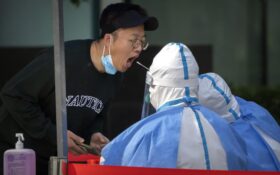
All residents are required to undergo three virus tests during the week as authorities seek to detect and isolate cases without imposing the sort of sweeping lockdowns seen in Shanghai and elsewhere. A negative test result obtained within the previous 48 hours is required to enter most public spaces.
Beijing on Thursday reported just 50 new cases, eight of them asymptomatic.
Shanghai also saw a drop to 4,651 new cases, all but 261 asymptomatic, with an additional 13 deaths. China’s biggest city recorded a daily peak of 27,605 new cases on April 13.
Questions have arisen about the surprisingly low death toll amid an outbreak of more than 400,000 cases in the city that is home to China’s main stock market and biggest port.
The Associated Press contributed to this article.