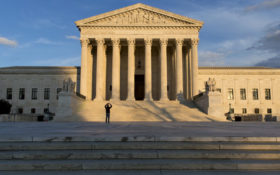
The Supreme Court has agreed to review a case involving a federal law that gives Native Americans preference in adoptions of Native children.
The high court said Monday it would take the case that presents the most significant legal challenges to the Indian Child Welfare Act since it was passed in 1978. The law has long been championed by Native American leaders as a means of preserving their families and culture.
The law gives Native American families priority in foster care and adoption proceedings involving Native children, and it places reporting and other requirements on states. A federal appeals court in April upheld the law and Congress’ authority to enact it. But the judges also found some of the law’s provisions unconstitutional, including preferences for placing Native American children with Native adoptive families and in Native foster homes.
The case won’t be argued until after the high court begins its new term in October.
Texas, Louisiana, Indiana and seven individuals — three non-Native couples and the biological mother of a Native American child that was adopted by a non-Native family — had sued over provisions in the law. The children are enrolled or potentially could be enrolled as Navajo or Cherokee, White Earth Band of Ojibwe, and Ysleta del Sur Pueblo.
A federal district court in Texas initially sided with the group of plaintiffs in 2018 and struck down much of the law, ruling it was unconstitutional because it was race-based and violates the Equal Protection Clause.
But in 2019, a three-judge federal appeals court panel voted 2-1 to reverse the district court and uphold the law. The full court then agreed to hear the case, and struck some provisions. It upheld the determination that the law is based on the political relationship between the 574 federally recognized tribes and the U.S. government, not race.
The Biden administration asked the Supreme Court to review the case, arguing that the provisions should not have been struck.
Before the Indian Child Welfare Act was passed, between 25% and 35% of Native American children were being taken from their homes and placed with adoptive families, in foster care or in institutions. Most were placed with white families or in boarding schools in attempts to assimilate them.
The Associated Press contributed to this article.