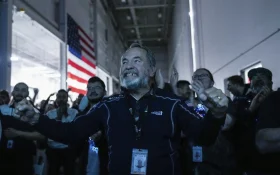
A private lander on Thursday made the first U.S. touchdown on the moon in more than 50 years, but managed just a weak signal back until flight controllers scrambled to gain better contact.
Despite the spotty communication, Intuitive Machines, the company that built and managed the craft, confirmed that it had landed upright. But it did not provide additional details, including whether the lander had reached its intended destination near the moon’s south pole. The company ended its live webcast soon after identifying a lone, weak signal from the lander.
“What we can confirm, without a doubt, is our equipment is on the surface of the moon,” mission director Tim Crain reported as tension built in the company’s Houston control center.
Added Intuitive Machines CEO Steve Altemus: “I know this was a nail-biter, but we are on the surface and we are transmitting. Welcome to the moon.”
Data was finally starting to stream in, according to a company announcement two hours after touchdown.
The landing put the U.S. back on the surface for the first time since NASA’s famed Apollo moonwalkers.
Intuitive Machines also became the first private business to pull off a lunar landing, a feat achieved by only five countries. Another U.S. company, Astrobotic Technology, gave it a shot last month, but never made it to the moon, and the lander crashed back to Earth. Both companies are part of a NASA-supported program to kick-start the lunar economy.
Astrobotic was among the first to relay congratulations. “An incredible achievement. We can’t wait to join you on the lunar surface in the near future,” the company said via X, formerly Twitter.
Intuitive Machines “aced the landing of a lifetime,” NASA Administrator Bill Nelson tweeted.
Take a look at NASA’s broadcast —
The final few hours before touchdown were loaded with extra stress when the lander’s laser navigation system failed. The company’s flight control team had to press an experimental NASA laser system into action, with the lander taking an extra lap around the moon to allow time for the last-minute switch.
With this change finally in place, Odysseus descended from a moon-skimming orbit and guided itself toward the surface, aiming for a relatively flat spot among all the cliffs and craters near the south pole.
As the designated touchdown time came and went, controllers at the company’s command center anxiously awaited a signal from the spacecraft some 250,000 miles (400,000 kilometers) away. After close to 15 minutes, the company announced it had received a weak signal from the lander.
Launched last week, the six-footed carbon fiber and titanium lander — towering 14 feet (4.3 meters) — carried six experiments for NASA. The space agency gave the company $118 million to build and fly the lander, part of its effort to commercialize lunar deliveries ahead of the planned return of astronauts in a few years.
Intuitive Machines’ entry is the latest in a series of landing attempts by countries and private outfits looking to explore the moon and, if possible, capitalize on it. Japan scored a lunar landing last month, joining earlier triumphs by Russia, U.S., China and India.
The U.S. bowed out of the lunar landscape in 1972 after NASA’s Apollo program put 12 astronauts on the surface. Astrobotic of Pittsburgh gave it a shot last month, but was derailed by a fuel leak that resulted in the lander plunging back through Earth’s atmosphere and burning up.
Intuitive Machines’ target was 186 miles (300 kilometers) shy of the south pole, around 80 degrees latitude and closer to the pole than any other spacecraft has come. The site is relatively flat, but surrounded by boulders, hills, cliffs and craters that could hold frozen water, a big part of the allure. The lander was programmed to pick, in real time, the safest spot near the so-called Malapert A crater.
The solar-powered lander was intended to operate for a week, until the long lunar night.
Besides NASA’s tech and navigation experiments, Intuitive Machines sold space on the lander to Columbia Sportswear to fly its newest insulating jacket fabric; sculptor Jeff Koons for 125 mini moon figurines; and Embry-Riddle Aeronautical University for a set of cameras to capture pictures of the descending lander.
The Associated Press contributed to this article.