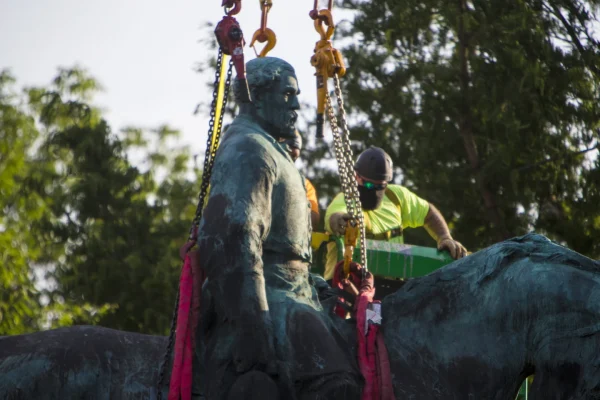
In the 21st century, dozens of statues have been torn down in public parks, and others have been taken into storage.
Now, one has even been melted down.
A statue of Confederate Gen. Robert E. Lee has been melted down and will be repurposed into new works of art. The Jefferson School African American Heritage Center, a Charlottesville-based Black history museum, said Thursday that the statue had been demolished and released video of it melting.
The Charlottesville City Council voted in 2021 to donate the statue to the heritage center, after it proposed a Swords into Plowshares project that would melt the statue and repurpose it into “public art that expresses the City’s values of inclusivity and racial justice,” according to the proposal submitted to the city.
The statue was taken down in 2021 after years of debate.
The heritage center director, Andrea Douglas, claims to be trying “not to remove history but bear witness to the truths about our racist pasts and our aspirations for a more equitable future.”
Preservationists have voiced their desire to keep the statue standing… or even just to turn the metal into a historically accurate, Civil War-style cannon.
In fact, two groups sued last year to try to block the city from donating it to the heritage center, but a judge tossed out their case.
Jalane Schmidt, a University of Virginia professor, was present at the melting. “No cannons,” she told the Washington Post.
Some public figures have called to destroy not only Confederate-themed statues, but also some statues of our nation’s founding fathers. In 2021, New York City’s Public Design Commission removed a statue of Thomas Jefferson from the city council’s chambers.
“Jefferson embodies some of the most shameful parts of our country’s history,” Councilmember Adrienne Adam said at a hearing on whether to move the statue.
However, even after this, the University of Virginia professor has dismissed concerns about a slippery slope effect.
“We are taking the moral risk associated with melting it down,” Schmidt told the Post during the melting. “In the hope of creating something new.”
Besides the preservationists, some violent protestors assembled at the “Unite the Right” rally in 2017. During that rally, a man intentionally drove his car into a crowd of far-Left protesters, killing 32-year-old Heather Heyer and injuring 19 others. He is serving a life sentence.
At the melting, the foundry owner worried about the risk of threats from violent protestors.
“The risk is being targeted by people of hate, having my business damaged, having threats to family and friends,” the foundry owner said.
However, the metalworker felt an obligation to melt the statue, anyway, and he fired up the 2,250-degree furnace.
“When you are approached with such an honor, especially to destroy hate, you have to do it,” he continued. “It is time to dismantle this hate, this infection that has plagued our beautiful country.”
At a news conference Thursday, heritage center officials said they now plan to solicit proposals on how to repurpose the statue. The center hopes to pick an artist next year and is conducting a $4 million fundraising campaign.
For now, the bronze from the statue has been molded into ingots stamped with the words “SWORDS INTO PLOWSHARES,” some of which were on display at the news conference.
A Post reporter shot videos of the statue’s melting.
Take a look —
Charlottesville’s Robert E. Lee statue has met its end, in a 2,250-degree furnace.
The divisive Confederate monument, the focus of the deadly “Unite the Right” rally in 2017, was secretly melted down and will become a new piece of public art.
More on the process:… pic.twitter.com/XatZUfvku3
— The Washington Post (@washingtonpost) October 26, 2023
The statue’s defenders more recently sought to block the city from handing over Lee to the Charlottesville’s Black history museum, which had proposed a plan to repurpose the metal. In a lawsuit, those plaintiffs suggested the monument should remain intact or be turned into Civil… pic.twitter.com/D80282TZYv
— The Washington Post (@washingtonpost) October 26, 2023
The Horn editorial team and the Associated Press contributed to this article.