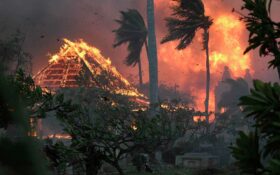
The wildfire that has brought sheer devastation to Maui is especially heartbreaking for Hawaii because it struck one of its most historic towns and the onetime capital of the former kingdom.
And one helicopter pilot obtained some heartbreaking flyover footage.
Lahaina, in western Maui, has amassed a long history. The town was once the royal residence of King Kamehameha, who unified Hawaii under a single kingdom by defeating the other islands’ chiefs. His successors made it the capital from 1820 to 1845, according to the National Park Service.
Kings and queens are buried in the graveyard of the 200-year-old stone Wainee Church. Later named Waiola, the church that once sat up to 200 people was photographed apparently engulfed in flames this week.
In Lahania alone, dozens of people were killed and hundreds of structures were damaged or destroyed in the blaze that ignited Tuesday and quickly spread — throughout this community of fewer than 13,000 residents.
Richard Olsten, a helicopter pilot with tour operator Air Maui, said he and other pilots and mechanics flew over the scene Wednesday before work to take stock.
“All the places that are tourist areas, that are Hawaiian history, are gone, and that can’t be replaced,” he said. “You can’t refurbish a building that’s just ashes now. It can’t be rebuilt — it’s gone forever.”
A flyover of historic Lahaina showed entire neighborhoods that had been a vibrant vision of color and island life reduced to gray ash.
Block after block was nothing but rubble and blackened foundations, including along famous Front Street, where tourists shopped and dined just days ago. Boats in the harbor were scorched, and smoke hovered over the town, which dates to the 1700s and is the biggest community on the island’s west side.
Olsten added, “This looks like Baghdad or something.”
Take a look at Olsten’s video… and a photo of the Waiola church.
The Waiola Church in Lahaina was lost in the fires, according to a minister. The church was founded as the island’s first Christian mission at the invitation of Queen Ka’ahumanu, while Lahaina was the capital of the Kingdom of Hawaii from 1820-45. https://t.co/sINabLd57g pic.twitter.com/rwuKWHgxLa
— San Francisco Chronicle (@sfchronicle) August 11, 2023
It’s feared that the fire also consumed what is believed to be the United States’ largest banyan, a fig tree with aerial roots that grow out of branches and eventually reach the soil and become new trunks.
The Lahaina Historic District is home to more than 60 historic sites, according to the Advisory Council on Historic Preservation. A National Historic Landmark since 1962, it encompasses more than 16,000 acres (6,500 hectares) and covers ocean waters stretching a mile (1.6 kilometers) offshore from the storied buildings.
The district’s Lahainaluna High School was where royalty and chiefs were educated, and also where Kamehameha and his Council of Chiefs drafted the first Declaration of Rights of the People and the Constitution for the Hawaiian Kingdom.
The capital was moved to Honolulu in 1845, but Lahaina’s palace remained a place where royalty would visit.
Lahaina also has a rich history of whaling, with more than 400 ships a year visiting for weeks at a time in the 1850s. Crew members sometimes clashed with missionaries on the island.
Sugar plantations and fishing boosted the economy over the decades, but tourism later became the main driver. Nearly 3 million visitors came to Maui last year, and many of them come to the historic town.
No one yet knows whether the fire deaths were concentrated on roads or inside homes.
However, business owner Tiffany Kidder Winn was assessing the damage Wednesday at the Whaler’s Locker gift store, she came upon a line of burned-out vehicles, some with charred bodies inside.
“It looked like they were trying to get out, but were stuck in traffic and couldn’t get off Front Street,” she told the Associated Press. She later spotted a body leaning against a seawall.
Winn said the destruction was so widespread, “I couldn’t even tell where I was, because all the landmarks were gone.”
Officials are still prioritizing search-and-rescue missions, according to Hawaii Emergency Management Agency spokesperson Adam Weintraub, and they have yet to search certain areas due to a lack of safe access.
The fire has been described as a “polycrisis” fueled by a surprising pair of contributors. It’s been worsened by both a dry summer and strong winds from Hurricane Dora. The fire started Tuesday and took Maui by surprise, racing through parched growth covering the island and then feasting on homes and anything else that lay in its path.
“Lahaina, with a few rare exceptions, has been burned down,” Hawaii Gov. Josh Green told The Associated Press. More than 1,000 structures were destroyed by fires that were still burning, he said.
Already the state’s deadliest natural disaster since a 1960 tsunami killed 61 people on the Big Island, the death toll will likely rise further as search and rescue operations continue, Green added.
The official death toll of 53 as of Thursday makes this the deadliest U.S. wildfire since the 2018 Camp Fire in California, which killed at least 85 people and laid waste to the town of Paradise. The Hawaii toll could rise, though, as rescuers reach parts of the island that had been inaccessible due to the three ongoing fires, including the one in Lahaina that was 80% contained on Thursday, according to a Maui County news release. Dozens of people have been injured, some critically.
Take a look at another video obtained by an AP reporter —
The Horn editorial team and the Associated Press contributed to this article.