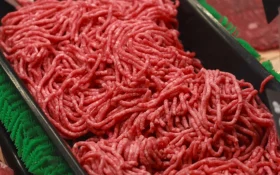
The U.S. Department of Agriculture (USDA) announced on Tuesday that it will begin testing ground beef for traces of the bird flu virus, known as Type A H5N1. Despite the new testing measures, officials remain confident that the nation’s meat supply is safe for consumption.
This decision comes after the virus was detected in nearly three-dozen dairy herds across nine states.
The USDA will conduct two studies to determine if particles of the bird flu virus are present in beef sold in states where dairy cows have tested positive, as well as in the muscles of dairy cows sent to slaughter.
A third study will investigate how cooking meat at various temperatures affects the virus, using a bird flu surrogate.
Last week, the U.S. Food and Drug Administration (FDA) confirmed the presence of non-infectious remnants of the bird flu virus in pasteurized milk.
However, experts emphasize that these particles are inactive and do not pose a risk to consumers.
Scientists maintain that there is no evidence to suggest that people can contract bird flu by consuming food that has been properly pasteurized or cooked.
The bird flu virus was first discovered in dairy cows this spring, and since then, H5N1 has been found in the lung tissue of a dairy cow that was culled and sent to slaughter.
Despite this, officials from the U.S. Centers for Disease Control and Prevention (CDC) have not observed any signs that the virus is evolving to become more transmissible to humans.
Since the outbreak began, two farmworkers have been infected with bird flu.
The Associated Press contributed to this article.