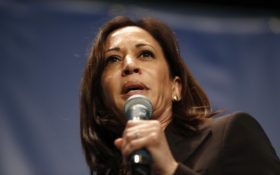
Democratic presidential candidate Kamala Harris said Wednesday that if she wins the White House, her Justice Department “would have no choice” but to pursue criminal charges against President Donald Trump after he leaves office.
Her promise to her voters: She’ll lock Trump up.
The California senator and some other Democrats in the 2020 race are pushing their party to initiate the impeachment process after special counsel Robert Mueller ’s report on Russian interference in the 2016 election. Mueller has said he didn’t recommend criminal charges partly the Justice Department won’t indict a sitting president — and partly because he found no evidence of collusion.
“Everyone should be held accountable,” Harris told NPR in an interview broadcast Wednesday. “And the president is not above the law.”
Harris, a former California attorney general, later said she would not dictate the outcome of any prospective efforts to charge Trump. “The facts and the evidence will take the process where it leads,” she said.
Suggesting that Trump face prosecution after he leaves office is a fine line for any Democrat after liberals accused him of politicizing the Justice Department when he threatened prosecute his rival, Hillary Clinton, during the 2016 campaign.
Harris is not alone among 2020 Democratic presidential hopefuls in criticizing the Justice Department policy that Mueller cited in declining to look at obstruction charges in his nearly two-year investigation into Russian meddling.
Massachusetts Sen. Elizabeth Warren, the first candidate to fully endorse the start of impeachment proceedings after Mueller’s report, pledged last month to end that policy if she’s elected president.
Nearly half of the more than 20 Democratic primary candidates are calling for the start of an impeachment inquiry, Harris and Warren among them. Few contenders, though, are making that stance a centerpiece of their campaigns.
But Harris, needing a polling boost, appears to have taken a step farther and swore her administration would look at charging Trump with obstruction once he no longer is president.
The Associated press contributed to this article