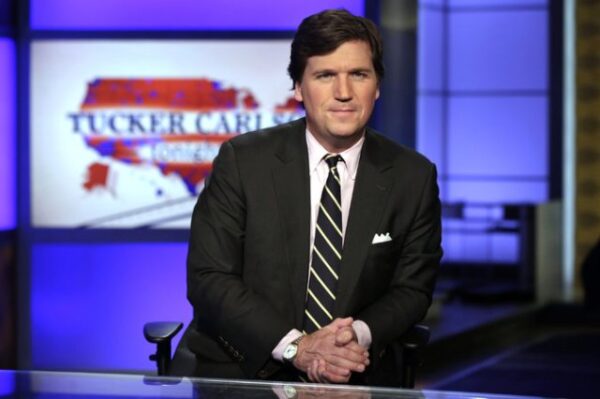
Former Fox News star and conservative activist Tucker Carlson revealed an explosive censorship bombshell during an interview with Wikipedia co-founder Larry Sanger — and it’s worse than expected.
Tucker had Sanger describe the systematic censorship and far-Left bias on the platform during a wide-ranging interview that exposed the online encyclopedia secret blacklist of conservative news sources.
Anonymous editors who wield enormous power over the website have a secret pact to censor conservative voices.
Sanger, who left Wikipedia in 2002 after helping launch the popular website, guided Carlson through the site’s “perennial sources” page, which categorizes news outlets based on reliability.
The color-coded list reveals a stark political divide: conservative outlets like Fox News, Breitbart, The Daily Caller, The Epoch Times, The New York Post and The Federalist are marked in red as unreliable, while left-leaning sources including The New York Times, The Washington Post, CNN, The Nation, Mother Jones, and GLAAD receive green-light approval.
“Come on!” Carlson exclaimed.
“Red means it’s blacklisted. You cannot cite it as a source of facts,” Sanger explained.
The Wikipedia co-founder said an account named “Mr. X” is responsible for maintaining the blacklist, though it’s edited by numerous individuals. The list was established in 2017, the year President Donald Trump first took office.
“I never hear about this! And we don’t know who made this decision?” Carlson asked. “This is kind of incredible.”
Sanger revealed that 85 percent of Wikipedia’s 62 most powerful editorial accounts — including administrators and arbitration committee members — operate anonymously, wielding influence over one of the world’s most-visited websites without accountability.
“These are the people who are shaping Americans’ understanding of the world, of their own country, of themselves, of reality itself. And we don’t know who they are because their identities are hidden,” Carlson said.
The anonymous editors can “libel people with impunity,” according to Sanger, who pointed out that Wikipedia enjoys Section 230 immunity protecting it from lawsuits in the United States.
Sanger described how Wikipedia’s original neutrality policy has been corrupted over time to favor “GASP” viewpoints; Globalist, Academic, Secular, and Progressive. The current policy allows editors to censor conservative views as “fringe theories” or “conspiracy theories.”
“Wikipedia developed in tandem with the development of media,” Sanger explained. “As media from the founding of Wikipedia in 2001 to about 2012 became solidified in a center-left establishment standpoint, Wikipedia read a lot like The New York Times or the BBC.”
The transformation accelerated around 2016, Sanger said, when the website began attacking Trump as a liar and conservative pundits as “conspiracy theorists.”
Sanger also raised concerns about the Deep State’s influence on Wikipedia. In 2006-2007, research by Virgil Griffiths that identified edits coming from CIA headquarters in Langley, Virginia.
“Wikipedia is like just a gold mine for the intelligence agencies of the world because it’s like a one-stop shop,” Sanger said. “A large part of the remit of intelligence today is to manipulate public opinion in various ways.”
The Southern Poverty Law Center is rated “generally reliable” despite having listed Charlie Kirk’s Turning Point USA on its “Hate Map” before Kirk’s September 10 assassination. The Nation is approved despite a history of bias, including having published an incorrect Kirk quote after his killing that required correction. ProPublica is deemed “generally reliable for all purposes” even though a majority of ethics experts it cited in stories about Supreme Court justices had records of donating to Democratic campaigns, according to Federal Election Commission records.
Sanger proposed nine reform theses to address Wikipedia’s problems:
1. End “Consensus” Decision-Making: Replace the current system that allows ideological groups to claim false unanimity and silence dissent.
2. Allow Competing Articles: Permit multiple versions of controversial topics from different perspectives instead of forcing one “official” narrative.
3. Abolish the Source Blacklist: Remove the “perennial sources” page that bans conservative outlets while approving left-leaning media.
4. Restore Original Neutrality Policy: Stop labeling dissenting views as “fringe” and return to true neutrality that presents all significant perspectives fairly.
5. Repeal “Ignore All Rules”: End the policy that lets powerful insiders bypass accountability while blocking others for minor infractions.
6. Identify Wikipedia’s Leaders: Require the 62 most powerful editors to reveal their real names and provide them liability insurance for accountability.
7. Add Public Article Ratings: Let readers rate and comment on articles, with transparent metrics showing different viewpoints and reliability assessments.
8. Stop Permanent Account Bans: End indefinite blocking, require multiple administrators to approve permanent bans, and allow appeals every 3-12 months.
9. Create an Elected Legislature: Hold a Constitutional Convention to establish a face-to-face editorial council with identified members operating on one-person, one-vote basis.
Carlson called Wikipedia “one of the worst things about our society” and compared the censorship to “Pravda but with much greater reach and a much more profound effect.”
“Wikipedia has a much greater effect on how people understand the world than any [mainstream] media outlets,” Carlson said. “Wikipedia is a media outlet and it’s never included in the list of corrupt media outlets.”
Sanger called on conservatives, libertarians, and others concerned about Wikipedia’s censorship to organize and attempt to reform the platform from within, though he acknowledged the difficulties of working within a system controlled by ideological opponents.
“If we’re going to stop this crazy strain of left-wing violence, we have to be honest about what it is,” Sanger said.
Take a look —