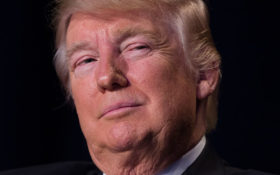
When President Donald Trump returns to the Conservative Political Action Convention (CPAC) 2017, it marks the beginning of the end of the Republican Party.
It’s now the Trump Party.
Six years ago, Trump stepped out before the nation’s largest gathering of conservative activists for the first time. The crowd, then loyal to party establishment figures, was hostile, occasionally booing the businessman-turned-politican.
On Friday he returns to CPAC with “Hail to the Chief” playing — and the audience will have changed its boos to cheers.
Trump’s upcoming speech is designed to be one of appreciation, White House senior strategist Steve Bannon said Thursday. “He understands, at CPAC there are many, many, many voices,” he said. “This is the room where he got his launch.”
Bannon said Breitbart News, which he led before joining Trump’s team last summer, and other conservative outlets first took note of the brash billionaire at his CPAC debut. And that’s where Trump first began understanding the conservatives who years later would help him win the presidency.
“He wasn’t familiar with CPAC when we introduced the concept to him,” said Roger Stone, Trump’s longtime informal political adviser. He said he thought Trump did quite well in that first appearance — “when you consider that he’s not a pure ideologue. He’s a populist with conservative instincts.”
Stone and a gay Republican group had arranged the last-minute appearance, which Trump locked in with a donation to the American Conservative Union, which hosts the conference.
Although Trump returned most years afterward, he was notably absent last year. ACU chairman Matt Schlapp said the presidential candidates were asked to participate in a question-and-answer session, but Trump wanted to make a speech.
He did show up in 2015, however, a few months before he announced his candidacy.
“I am really inclined. I want to do it so badly,” Trump said about the likelihood he’d run. Kentucky Sen. Rand Paul and Wisconsin Gov. Scott Walker were the top two choices in that year’s straw poll.
Now, CPAC is largely the Trump show — “TPAC,” White House counselor Kellyanne Conway called it. She, Bannon and other administration officials spoke Thursday, and Vice President Mike Pence gave a keynote address.
Schlapp said Trump will be the first president to address the group during his first year in office since Ronald Reagan in 1981. He called that a “huge sign of respect.”
Trump’s first speech to the group bore little resemblance to the mega-rallies that were the hallmark of his presidential campaign, although many of the themes were the same.
Then, no one in the crowd cheered or applauded when he explained why he might run for president.
Now, he IS president.
In 2011, he vowed to repeal President Barack Obama’s health care law. He promised to create “vast numbers of productive jobs” and not to raise taxes. A Trump presidency, he predicted, would mean for the U.S. “hundreds of billions of dollars from other countries that are screwing us.”
And he appeared to test-drive the “make America great again” phrase that would become his 2016 presidential campaign slogan. “Our country will be great again,” he said. He trademarked that phrase in 2012, just after Mitt Romney lost to Obama.
He told the skeptical crowd: “I have a reputation for telling it like it is. I’m known for my candor.”
He seemed to back that up later.
Near the end of the 2011 speech he told the skeptical crowd that he was only thinking about running because he didn’t like any of the potential candidates — prompting shouts of “Ron Paul” to break out. A Texas congressman at the time, Paul was a fan favorite of CPAC and won its straw poll that year.
Trump looked amused and shook his head. “By the way, Ron Paul cannot get elected, I’m sorry.” he said. Loud boos erupted as Trump reiterated, “Zero chance of getting elected.”
An angry Republican audience member shouted: “You have zero chance of getting elected.”
Now, the crowd will be shouting something far different.
“Drain the swamp!”
The Associated Press contributed to this article