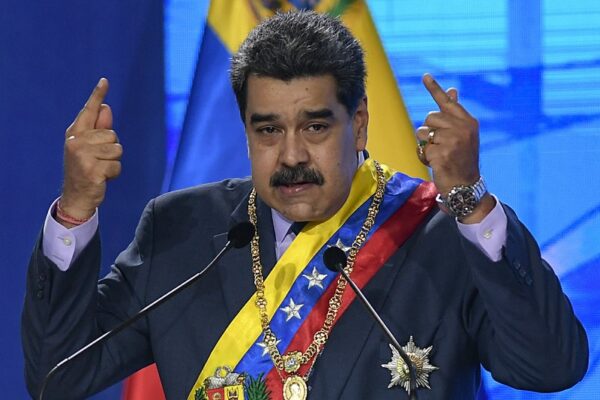
President Donald Trump delivered an icy warning to Venezuelan dictator Nicolas Maduro during their recent phone call: Flee the country immediately, and Maduro can save himself and his family
Or else.
Trump confirmed the warning Sunday aboard Air Force One.
“I don’t want to comment on it. The answer is yes,” Trump told reporters. “I wouldn’t say it went well, or badly. It was a phone call.”
Trump reportedly offered a guarantee of a safe evacuation for Maduro, his wife Cilia Flores, and their son… but only if the dictator agreed to resign. The conversation quickly reached an impasse as Washington and Caracas remained far apart on terms.
“First, Maduro asked for global amnesty for any crimes he and his group had committed, and that was rejected,” a source familiar with the call told The Miami Herald. “Second, they asked to retain control of the armed forces — similar to what happened in Nicaragua in ’91 with Violeta Chamorro. In return, they would allow free elections.”
The final sticking point was timing. Washington demanded immediate resignation. Caracas refused.
After the call collapsed, Trump escalated pressure dramatically.
He announced Saturday that Venezuelan airspace should be considered “closed in its entirety.” The administration also designated the Cartel de los Soles, which it says is headed by Maduro and top officials, as a Foreign Terrorist Organization.
Trump warned that U.S. land-based operations targeting drug-trafficking networks inside Venezuela could begin “very soon.” A massive U.S. military force has gathered near Venezuela, including the USS Gerald R. Ford aircraft carrier.
NOW – Trump says not to read anything into his warning about Venezuelan airspace, it doesn't mean an airstrike is imminent and that he did have a call with Maduro, "I wouldn't say it went well or badly, it was a phone call." pic.twitter.com/56BdtnxYlz
— Disclose.tv (@disclosetv) November 30, 2025
“I think the operations will start imminently,” Former Venezuelan diplomat Vanessa Neumann said. “The clearing of the airspace is an indication and a very clear public warning that missiles might be coming to take out command and control infrastructure or retaliatory infrastructure.”
The U.S. military has conducted strikes on drug vessels in the Caribbean Sea and eastern Pacific Ocean since early September, killing more than 80 suspected terrorists. The Trump administration says the operations target cartel-controlled smuggling vessels.
Venezuela’s government responded to Trump’s airspace declaration by accusing the president of making a “colonial threat.” The Foreign Ministry said the statement was “a hostile, unilateral and arbitrary act” intended to undermine the country’s “territorial integrity, aeronautical security and full sovereignty.”
Republican Senator Markwayne Mullin said Sunday on CNN that the United States has offered Maduro the chance to leave his country for Russia or elsewhere. The United States accuses Maduro of heading the Cartel de los Soles and has issued a $50 million reward for his capture.
The Trump administration does not recognize Maduro as the legitimate winner of last year’s presidential election.
Neumann said Venezuela’s military forces have been weakened by years of corruption, sanctions, defections, and lack of maintenance.
“Their material is extremely old, decayed, and has not been serviced,” Neumann explained. “They’ve got junk from the Russians. The stuff they originally had from the Americans is decades old and has not been serviced. So, they have neither the personnel, foreign support, nor the material.”
She said Maduro’s biggest backers, Russia and Iran, are both weakened and dealing with their own issues.
“The timing is right now,” Neumann added. “Because even Maduro’s biggest backers, Russia and Iran, are both on the back foot, and China will not go that far in backing Maduro as it has bigger and broader interests throughout the region.”