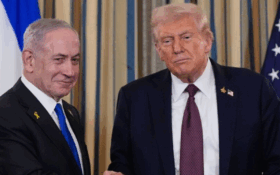
After Israeli Prime Minister Benjamin Netanyahu threw his support behind the U.S. peace plan for Gaza, the question now is whether Hamas will agree.
Hamas, a radical Islamic terror group, faces a bitter tradeoff — the proposal demands that the Islamist terror group effectively surrender in return for uncertain gains. But if it rejects the deal, the U.S. could give Israel an even freer hand to continue its punishing campaign in the already devastated territory.
Under the proposal, the Islamic terror group would have to disarm in return for an end to fighting, humanitarian aid for Palestinians, and the promise of reconstruction in Gaza — all desperately hoped for by the civilian population that Hamas controls.
But the proposal has a promise that some day, Palestinian statehood would be possible but isn’t specific with details. For the foreseeable future, Gaza and its more than 2 million Palestinians would be put under international control. An international security force would move in, and a “Board of Peace” headed by Trump and former British Prime Minister Tony Blair would oversee Gaza’s administration and reconstruction.
Trump and Netanyahu said they agreed on the plan Monday after talks at the White House.
The proposal includes one provision that Netanyahu and his hard-line government most strongly oppose: It says the Palestinian Authority will eventually govern Gaza.
The White House issued the text on Monday of its 20-point proposal. Here is what to know.
The ceasefire
The plan calls for all hostilities to immediately end. Within 72 hours, Hamas would release all their remaining hostages they’ve held for two years, living or dead. The militants still hold 48 civilian hostages — 20 of whom are believed by Israel to still be alive.
In return, Israel would free 250 Palestinian terrorists serving life sentences in its prisons as well as 1,700 people detained from Gaza since the war began, including all women and children. Israel would also hand over the bodies of 15 Palestinians for each body of a hostage handed over.
Troop withdrawal
The plan calls for an Israeli troop withdrawal. But it would only take place after Hamas disarms and as the international security force deploys to fill in areas that Israeli forces leave.
Israel would also maintain a “security perimeter presence” – which would mean it would keep a buffer zone inside Gaza. Over 1,200 Israeli citizens were butchered — including babies beheaded and burned alive — the last time Hamas broke through the Israeli buffer zone on October 7, 2023, which ignited the conflict.
Those terms could bring pushback from Hamas, which has said it will not release all its hostages unless it receives a “clear declaration” the war will end and Israel will leave Gaza completely.
The fate of Hamas and postwar Gaza
Hamas would have no part in administering Gaza, and all its military infrastructure — including the tunnels the Islamic terror group uses to shield themselves under civilian centers, schools, and hospitals — would be dismantled. Members who pledge to live peacefully would be granted amnesty, and those who wish to leave Gaza would be allowed to.
The international security force would ensure Hamas’ disarmament and keep order. It would also train Palestinian police to take over law enforcement. Mediator Egypt has said it is training thousands of Palestinian police to deploy to Gaza.
Meanwhile, humanitarian aid would be allowed to flow into Gaza in large amounts and would be run by “neutral international bodies,” including the U.N. and the Red Crescent. It is unclear whether the Gaza Humanitarian Fund, an alternative food distribution system backed by Israel and the U.S., would continue to operate.
The plan also specifies that Palestinians will not be expelled from Gaza, and that there will be an international effort to rebuild the territory for Palestinians.
In normal cases, that might not need spelling out. But Palestinians have feared mass expulsion after both Trump and the Israeli government spoke of pushing out Gaza’s population in a “voluntary” manner and rebuilding the strip.
The interim administration of Palestinian technocrats would run day-to-day affairs in Gaza. But it would be overseen by the “Board of Peace.” The board would also supervise funding of reconstruction, a role that could give it enormous power over governing Gaza since that is the biggest task facing the territory, almost completely destroyed by Israel’s campaign.
The Palestinian Authority and statehood
During this interim administration, the Palestinian Authority would undergo reforms so it can eventually take over governing Gaza.
The plan has only a slight nod to the issue of statehood. It says that if the Palestinian Authority reforms sufficiently and Gaza redevelopment advances, “the conditions may finally be in place for a credible pathway to Palestinian self-determination and statehood.”
The response so far
Qatar’s prime minister and Egypt’s intelligence chief shared the 20-point plan Monday evening with Hamas negotiators. The Hamas negotiators said they would review it in good faith and provide a response.
The Islamic terror group has so far rejected disarmament, saying it will fight until Israel is destroyed completely and all Jews in the country murdered.
Arab countries appear to back the outline. The governments of Egypt, Jordan, Indonesia Pakistan, Turkey, Qatar, Saudi Arabia, and United Arab Emirates issued a joint statement applauding Trump’s proposal.
Netanyahu could face resistance from within his own ultra-nationalist coalition allies.
Finance Minister Bezalel Smotrich, who is part of Netanyahu’s security Cabinet, published a list of his “red lines” on X on Monday. Top among them, he wrote, any deal must not allow involvement of the Palestinian Authority in Gaza or allow a Palestinian state. Smotrich is one of the more vocal members of the right-wing bloc of Netanyahu’s coalition who have previously threatened to leave the government if Netanyahu halts the war in Gaza.
Netanyahu may see a loophole. The proposal makes PA involvement in Gaza conditional on it completing internal reforms, which it pledged to do, saying it welcomed Trump’s plan to end the war.
But in his comments alongside Trump on Monday, Netanyahu expressed his belief it will never successfully do so.
The Associated Press contributed to this report.