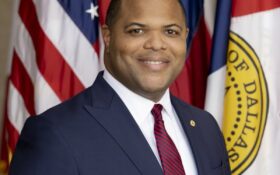
Prior to Friday, Democrats controlled the mayors’ offices in each of our nation’s 10 largest cities.
But the mayor of Dallas just changed that.
Dallas Mayor Eric Johnson, 47, announced his change in party affiliation on Friday.
“My priority has been to make the city safer, stronger and more vibrant. That meant saying no to those who wanted to defund the police. It meant fighting for lower taxes and a friendlier business climate. And it meant investing in family friendly infrastructure such as better parks and trails. That approach is working,” Johnson wrote in a guest column for the Wall Street Journal.
“I have no intention of changing my approach to my job. But today I am changing my party affiliation.”
In the column, Johnson blasted local Democrats for “finding new ways to thumb their noses at Republicans at the state or federal level,” for “proposing half-baked government programs that aim to solve every single societal ill,” and for “policies that exacerbate homelessness, coddle criminals and make it harder for ordinary people to make a living.”
“Enough,” Johnson said. “The future of America’s great urban centers depends on the willingness of the nation’s mayors to champion law and order and practice fiscal conservatism. Our cities desperately need the genuine commitment to these principles (as opposed to the inconsistent, poll-driven commitment of many Democrats) that has long been a defining characteristic of the GOP.”
Johnson served in the Texas House of Representatives from 2010 to 2020. He even served on several powerful committees… as a Democrat.
However, Johnson admitted to a distant relationship with the other Texas Democrats.
“I was never a favorite of the Democratic caucus, and the feeling was mutual,” Johnson wrote. “During the decade I spent serving my hometown in the Texas House of Representatives, I was a Democrat in a Republican-controlled Legislature. I prided myself on finding common-sense solutions and worked closely with my conservative colleagues to improve policing, public education and water infrastructure.”
Even after changing parties, Johnson looks unlikely to have changed any plans for his future.
Johnson talked about his plans to vote in next year’s Republican primary, but Texas is one of the 17 states with open primaries. Any registered voter, regardless of party affiliation, can request a Republican ballot in the primaries.
Plus, Johnson intends to retire from elected office at the end of his current term in 2027. In other words, he doesn’t plan to run for office as a Republican. Even while in office, Johnson has remained a partner at a private-sector law firm, and he looks likely to work there full time after reaching his term limit in 2027.
Johnson himself acknowledged this continuity.
“In the coming years, I will continue to pursue my three-pronged goal for Dallas: to become the safest major city in America with the best park system in Texas and the lowest taxes in our fast-growing North Texas region,” Johnson said. “And I intend to keep the promise I made to Dallas voters in 2019 and refrain from endorsing candidates seeking partisan political office while I am mayor.”
Plus, Johnson looks unlikely to get along with the Texas Republicans. Even while blasting the Democrats, Johnson chided Republicans for ignoring electoral opportunities in our nation’s urban centers.
“American cities need Republicans—and Republicans need American cities. When my political hero Theodore Roosevelt was born, only 20% of Americans lived in urban areas. By the time he was elected president, that share had doubled to 40%. Today, it stands at 80%. As America’s cities go, so goes America.”
Johnson has become the only Republican currently leading one of the nation’s ten largest cities.
The mayor of San Antonio, the nation’s sixth-largest city, is an independent, and Republican mayors are currently leading 25 of the nation’s 100 largest cities.
The Horn editorial team