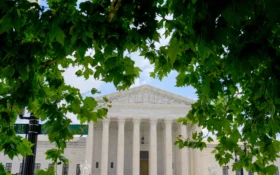
A divided Supreme Court on Tuesday upheld a broad conception of birthright citizenship, rejecting President Donald Trump’s executive order declaring that children born to people who are in the United States illegally or temporarily are not American citizens.
By a 6-3 vote, the court struck down Trump’s order. A bare majority of five justices, in an opinion written by Chief Justice John Roberts, held that the long-settled understanding of the 14th Amendment, adopted after the Civil War, makes a citizen of anyone born in the country, with very limited exceptions.
It is regularly exploited now that air travel is common by foreign mothers, who seek citizenship for their soon-to-be-born children by traveling to the United States at the last minute.
“Citizenship, then and now, was the right to have rights—to freely participate in our political community. The Framers of the Fourteenth Amendment extended that promise to ‘every free-born person in this land,’” Chief Justice John Roberts wrote for the court, citing congressional debate over the amendment, “We keep that promise today.”
A sixth justice, Brett Kavanaugh, disagreed about the constitutional ruling, but pointed to a federal law that he said broadly conveys birthright citizenship.
Justices Samuel Alito, Neil Gorsuch, and Clarence Thomas would have upheld Trump’s proposed restrictions.
“The Court today takes the extraordinary step of holding facially unconstitutional the President’s Order excluding from citizenship the children of foreign temporary visitors and illegal aliens,” Justice Clarence Thomas wrote in a 91-page dissent, more than three times as long as Roberts’ opinion. “In doing so, the Court adds to the sad history of the Fourteenth Amendment, which was designed and understood to secure equal rights for the freed blacks but has instead been repurposed for political projects that the Reconstruction Congress did not support.”
The Republican president’s restrictions had been blocked by several lower courts and had not taken effect anywhere in the U.S.
Trump said the decision was “too bad for our Country” and suggested that Congress could “easily” address it with legislation. The majority decision rests on constitutional grounds. It would take an amendment to overcome the decision.
During arguments in April, both conservative and liberal justices questioned the order’s legality in a momentous case that was magnified by Trump’s unprecedented attendance in the courtroom.
The birthright citizenship order, which Trump signed on the first day of his second term, is part of his administration’s broad illegal immigration crackdown.
Trump’s order would have upended legal precedent that the 14th Amendment confers citizenship on anyone and everyone born in the U.S., excluding only the children of foreign diplomats and those born to a foreign occupying force.
The amendment was originally intended to ensure that Black people, including former slaves, had citizenship, though the Citizenship Clause is written more broadly. “All persons born or naturalized in the United States, and subject to the jurisdiction thereof, are citizens of the United States and of the State wherein they reside,” it reads.
In a series of decisions, lower courts have struck down Trump’s executive order as illegal. The decisions have invoked the high court’s 1898 ruling in Wong Kim Ark, which held that the U.S.-born child of Chinese nationals was a citizen.
Roberts, joined by Justice Amy Coney Barrett and the three liberal justices, said the amendment’s language, the historical context and the 1898 case make clear that children born to parents illegally or temporarily in the U.S. “are citizens at birth.”
But there was only a bare majority of five justices on the constitutional question.
Kavanaugh sided with the majority because of a federal law that makes those children citizens. But he joined the dissenters in finding that Trump’s order does not violate the Constitution. His view would enable a future Congress to change the law to restrict birthright citizenship.
The Trump administration had argued that the common view of citizenship is wrong, asserting that children of noncitizens are not “subject to the jurisdiction” of the United States and therefore are not entitled to citizenship.
The Associated Press contributed to this article