Scientists have discovered a surprising new lifeform that changes everything humans know about life.
A tiny single-celled organism in California’s Lassen Volcanic National Park has been discovered that survives in temperatures once thought impossible for anything to survive.
The amoeba, named Incendiamoeba cascadensis or “fire amoeba from the Cascades,” can grow and divide at temperatures up to 145 degrees Fahrenheit. The discovery breaks the previous record for heat tolerance in complex living organisms and alters what scientists believed possible for life on Earth… and beyond.
Beryl Rappaport, a microbiologist completing her Ph.D. at Syracuse University, led the research team that identified the new species. The work is still awaiting peer-review.
“Eukaryotes can grow at higher temperatures than we thought was possible for them,” Rappaport said.
Eukaryotes are organisms whose cells contain a nucleus and internal structures, and include everything from single-celled amoebas to animals and humans. Scientists previously believed these organisms could not survive above 140 degrees Fahrenheit.
The research team, which included Syracuse University microbiologist Angela Oliverio, collected water samples from hot springs at Lassen Volcanic National Park between 2023 and 2025. They found the fire amoeba in 14 of the 20 locations they sampled.
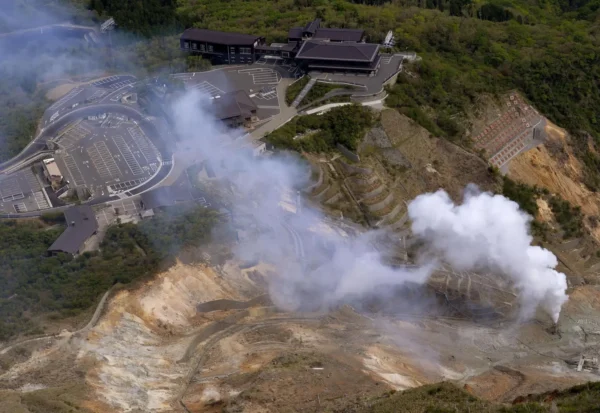
The park sits in California’s Cascade Range and features volcanic activity including steam vents, mud pots, and boiling pools. But Rappaport said the fire amoeba came from what appeared to be an unremarkable location.
“It’s the most uninteresting geothermal feature you’ll find in Lassen,” Rappaport said.
When researchers first examined water samples under a microscope, they saw no signs of life. After adding nutrients and culturing the samples at temperatures matching the stream, the amoeba appeared and began growing at 134 degrees Fahrenheit.
The scientists then tested the organism’s limits by slowly raising the temperature in their lab flasks. The fire amoeba sailed past the previous eukaryote record of 140 degrees and continued dividing at 145 degrees. It remained active at 146 degrees.
The amoeba stopped moving at 158 degrees but could revive if temperatures dropped back down. Only at 176 degrees did it finally die.
The organism requires temperatures of at least 108 degrees to grow at all, meaning it needs extreme heat to survive. Peak growth occurs around 131 to 134 degrees.
Analysis of the amoeba’s genome revealed special adaptations including heat-resistant proteins, expanded heat-shock chaperones, and rapid stress-response pathways that protect its delicate cellular components from melting in extreme temperatures.
“We need to rethink what’s possible for a eukaryotic cell in a significant way,” Oliverio said.
The discovery has implications beyond understanding unusual biology. Heat-tolerant proteins and enzymes from organisms like this could improve products including laundry detergent. But Oliverio is focused on larger questions about the limits of life.
“It raises a lot of interesting questions about what are the constraints,” Oliverio said. “And we have really no idea. We sampled the stream and got this amoeba from one geothermal area. There could be hotter things out there. There probably are.”
The research team found nearly identical DNA sequences in environmental samples from Yellowstone National Park and the Taupo Volcanic Zone in New Zealand. While DNA fragments do not prove living populations exist at those sites, they suggest related organisms may thrive in volcanic hotspots around the world.
Rappaport said the findings could help scientists search for life on other planets.
“Understanding the boundaries of life on Earth helps guide us for where to look for life elsewhere, and what kinds of life might be elsewhere,” Rappaport said.