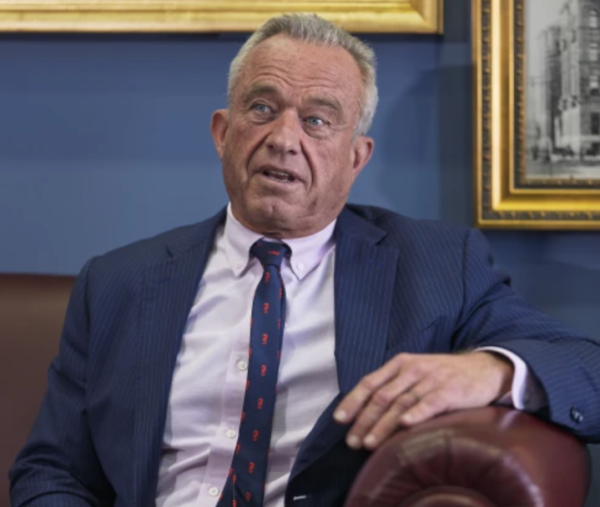
Health and Human Services Secretary Robert F. Kennedy, Jr.’s war on censorship just went to the next level — and he’s bringing the might of the entire federal government to bare.
The Department of Justice Antitrust Division is filing a statement of interest supporting an antitrust lawsuit by RFK Jr.’s organization against a powerful alliance of big tech and big media companies accused of colluding to censor rival news sources, Breitbart News reported Friday.
The case targets the left-leaning Trusted News Initiative, a partnership of 23 corporations and news giants that includes Meta and Google alongside major mainstream media outlets such as the BBC, Associated Press, Reuters, and The Washington Post. Together, these organizations claim to combat “harmful disinformation in real time” that “could threaten the integrity of democracy, particularly during elections.”
In other words, censorship.
“Partners alert each other to high risk disinformation so that content can be reviewed promptly by platforms, whilst publishers ensure they don’t unwittingly share dangerous falsehoods,” the Trusted News Initiative wrote.
Kennedy founded the Children’s Health Defense as part of a mission to end “childhood health epidemics” by “eliminating toxic exposure,” information which the TNI didn’t like… and suppressed on their global network.
“Federal antitrust law prohibits firms from colluding to deny critical facilities or market access to rivals. Such agreements are called ‘group boycotts,’ and they are per se illegal. The TNI is a massive group boycott. Since 2020, it has successfully denied critical market facilities—i.e., the world’s dominant social media platforms—to rival news publishers whose reporting competes with and challenges TNI orthodoxy. Under antitrust law, the victims of a group boycott—like the Plaintiffs in our case—are entitled to treble damages,” Children’s Health Defense wrote.
The Justice Department Antitrust Division, under Assistant Attorney General Gail Slater, has filed the statement of interest on Friday backing the Children’s Health Defense. The document represents the DOJ’s official position that antitrust laws should protect viewpoint competition in news markets against monopolistic, left-leaning censorship schemes.
The DOJ wrote that “the United States has a particular interest in ensuring that free market competition protect[s] individual liberty from the tyranny of coercive monopoly power.”
“Individual liberty—and consumer welfare—benefit greatly from viewpoint competition in news markets and can suffer when that competition is reduced. News consumers desire and demand diverse perspectives. Americans therefore vitally depend on viewpoint competition in the marketplace of ideas to limit the abuse of market power and ensure the free flow of information in our democracy,” the DOJ stated.
The Trump administration’s antitrust enforcers argued there’s existing legal precedent to protect information competition.
“The United States therefore files this statement to urge the Court to reject Defendants’ suggestion that the antitrust laws play no part in protecting viewpoint competition in news markets. Instead, controlling precedent shows that the Sherman Act protects all forms of competition, including competition in information quality. Existing doctrine under Section 1 of the Sherman Act, 15 U.S.C. § 1, thus provides an appropriate legal framework to evaluate Plaintiffs’ claims,” the DOJ wrote.
The Department of Justice has two primary arguments: that harms to competition from diverse rival news sources constitute antitrust injuries protected by the Sherman Anti-Trust Act, and that the Sherman Act outlaws actions that unreasonably restrains viewpoint competition.
The Justice Department noted that “the Supreme Court has recognized that the antitrust laws apply equally to news organizations as to any other type of commerce.”
“Thus, it is critical that the Sherman Act’s prohibitions apply equally when restraints of trade limit the type or quality of information that may compete in the marketplace for ideas. For nearly a century, the Supreme Court has recognized that the antitrust laws apply equally to news organizations as to any other type of commerce. ‘All are alike covered by the Sherman Act. The fact that the publisher handles news while others handle food does not, as we shall later point out, afford the publisher a peculiar constitutional sanctuary in which he can with impunity violate laws regulating his business practices,'” the DOJ said.
Today’s “online platforms control not just the prices of their services, but the flow of our nation’s commerce and communication [and] play a critical role in our digital public square.”
The case centers on allegations that TNI members censored opposition news content. TNI operates as “a joint effort by Defendants to stop ‘certain online news reporting’ that ‘competes with, and contradicts, Defendants’ own reporting,” the Children’s Health Defense claimed.
The defendants maintain they merely flag misinformation and “collectively decided what to count as misinformation.”
Kim Mack Rosenberg, Children’s Health Defense general counsel, praised the DOJ’s intervention and said it will help their case advance.
“The DOJ, which obviously has an interest in the enforcement of federal law, including antitrust law, is stepping in here, hopefully means this case will move forward,” he said.
The antitrust case represents an escalation in the Trump administration’s battle against big tech censorship The Justice Department’s aggressive stance reflects the Trump administration’s “America First Antitrust” policy aimed at empowering “America’s forgotten men and women” against left-learning corporate monopoly power.