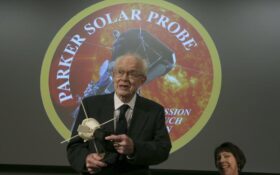
Eugene Parker, a physicist who theorized the existence of solar wind and became the first person to witness the launch of a spacecraft bearing his name, has died, his son and the University of Chicago said Wednesday.
His son, Eric Parker, said Eugene Parker died peacefully at a retirement community in Chicago on Tuesday, about a decade after being diagnosed with Parkinson’s disease. He was 94.
NASA administrators and university colleagues hailed Parker as a visionary in his field of heliophysics, focused on the study of the sun and other stars. He is best known for his 1958 theory of the existence of solar wind — a supersonic flow of particles off the sun’s surface.
“Dr. Eugene Parker’s contributions to science and to understanding how our universe works touches so much of what we do here at NASA,” NASA Administrator Bill Nelson said in a statement. “Dr. Parker’s legacy will live on through the many active and future NASA missions that build upon his work.”
Eugene Parker's work revolutionized our understanding of the universe and gave humanity the ability to 'touch the Sun.' He will be deeply missed. #ParkerSolarProbe pic.twitter.com/YgBUxtXQpw
— NASA Sun & Space (@NASASun) March 16, 2022
Parker recalled in 2018 that his solar wind theory was widely criticized and even mocked at publication. He was vindicated in 1962 when a NASA spacecraft mission to Venus confirmed his theory and solar wind’s effect on the solar system, including occasional disruptions of communications systems on Earth.
The experience became part of Parker’s identity as an educator and mentor.
“If you do something new or innovative, expect trouble,” he said in 2018 when asked to give advice to early career scientists. “But think critically about it because if you’re wrong, you want to be the first one to know that.”
Parker was born in 1927 in Houghton, Michigan. He studied physics at Michigan State University and California Institute of Technology, then worked as an assistant professor at the University of Utah before coming to the University of Chicago in 1955.
Eric Parker said he and his sister, Joyce, simply knew their dad was a scientist and didn’t learn about his stature in the field until later in their lives.
The elder Parker would occasionally rise from the dinner table to jot down an idea, his son said. But his children most remember Parker as an involved dad and an avid hiker, camper and craftsman who carved busts of famous figures from wood and made much of the family’s furniture.
“He always felt like workaholics were missing out,” Eric Parker said Wednesday. “He loved his job and he would tell you that when he discovered physics, he would have done it as a side gig because he enjoyed it so much. But he would also go on and on that if you’re getting over 40 hours a week in your job, you were missing out on the rest of life.”
In addition to his children, Eugene Parker is survived by his wife, Niesje, and three grandsons.
NASA honored Parker’s scientific contributions in 2018 by naming a spacecraft after him that was destined to travel straight into the sun’s crown. The Parker Solar Probe’s successful launch — which the then-91-year-old Parker attended — has since provided unprecedented close views of the sun.
Angela Olinto, dean of the physical sciences division at the University of Chicago, accompanied Parker to the launch. She recalled his seemingly boundless energy in the early morning hours preceding the launch and his childlike grin when everything went smoothly.
“He was this ideal of a physicist: a person who has a strong intuition, who can see one step ahead and who can then sit down and show the intuition is correct,” Olinto said
Dr. Nicola Fox, director of NASA’s Heliophysics Division, said Parker “was a visionary,” adding that she will miss sharing the latest data from the probe’s travels with him.
“Even though Dr. Parker is no longer with us, his discoveries and legacy will live forever,” Fox said.
The Associated Press contributed to this article.