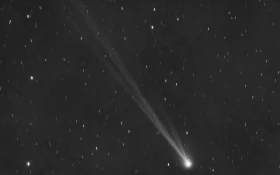
A newly discovered comet is swinging through our cosmic neighborhood for the first time in more than 400 years.
Stargazers across the Northern Hemisphere should catch a glimpse as soon as possible — either this week or early next — because it will be another 400 years before the wandering ice ball returns.
The comet, which is kilometer-sized (1/2-mile), will sweep safely past Earth on Sept. 12, passing within 78 million miles (125 million kilometers).
Early risers should look toward the northeastern horizon about 1 1/2 hours before dawn — to be specific, less than 10 or so degrees above the horizon near the constellation Leo. The comet will brighten as it gets closer to the sun, but will drop lower in the sky, making it tricky to spot.
Although visible to the naked eye, the comet is extremely faint.
“So you really need a good pair of binoculars to pick it out and you also need to know where to look,” said said Paul Chodas, manager of NASA’s Center for Near-Earth Object Studies.
The comet will come closest to the sun — closer than Mercury is — on about Sept. 17 before departing the solar system. That’s assuming it doesn’t disintegrate when it buzzes the sun, though Chodas said “it’s likely to survive its passage.”
Italian astronomer Gianluca Masi, founder of the Virtual Telescope Project, said in an email that the next week represents “the last, feasible chances” to see the comet from the Northern Hemisphere before it’s lost in the sun’s glare.
“The comet looks amazing right now, with a long, highly structured tail, a joy to image with a telescope,” he said.
If it survives its brush with the sun, the comet should be visible in the Southern Hemisphere by the end of September, Masi said, sitting low on the horizon in the evening twilight.
Stargazers have been tracking the rare green comet ever since its discovery by an amateur Japanese astronomer in mid-August. The Nishimura comet now bears his name.
It’s unusual for an amateur to discover a comet these days, given all the professional sky surveys by powerful ground telescopes, Chodas said, adding, “this is his third find, so good for him.”
The comet last visited about 430 years ago, Chodas said. That’s about a decade or two before Galileo invented the telescope.
The Associated Press contributed to this article.