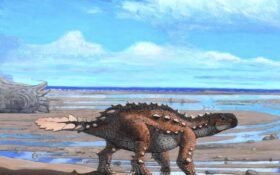
Fossils found in Chile are from a strange-looking dog-sized dinosaur species that had a unique slashing tail weapon, scientists reported Wednesday.
Some dinosaurs had spiked tails they could use as stabbing weapons and others had tails with clubs. The new species, described in a study in the journal Nature, has something never seen before on any animal: seven pairs of “blades” laid out sideways like a slicing weapon used by ancient Aztec warriors, said lead author Alex Vargas.
“It’s a really unusual weapon,” said Vargas, a University of Chile paleontologist. “Books on prehistoric animals for kids need to update and put this weird tail in there. … It just looks crazy.”
The plant-eating critter had a combination of traits from different species that initially sent paleontologists down the wrong path. The back end, including its tail weapon, seemed similar to a stegosaurus, so the researchers named it stegouros elengassen.
After Vargas and his team examined the pieces of skull and did five different DNA analyses, they concluded it was only distantly related to the stegosaurus. Instead, it was a rare southern hemisphere member of the tank-like ankylosaur family of dinosaurs. (Though the stegouros name stuck and can be easily confused with the more well-known stegosaurus.)
Vargas called it “the lost family branch of the ankylosaur.”
The fossil is from about 72 million to 75 million years ago and appears to be an adult based on the way bones are fused, Vargas said. It was found with its front end flat on its belly and the back end angled down to a lower level, almost as if caught in quicksand, Vargas said.
From bird-like snout to tail tip, stegouros stretched about six feet (two meters) but would only come up to the thighs of humans, Vargas said.
The tail was probably for defense against large predators, which were also likely turned off by armor-like bones jutting out that made stegouros “chewy,” Vargas said.
Not only is this “a really bizarre tail,” but it is from far southern Chile, “a region that hasn’t yielded these types of animals before,” said Macalester College biologist Kristi Curry Rogers, who wasn’t part of the study.
“We’re just scratching the surface when it comes to a comprehensive understanding of dinosaur diversity,” Rogers said. “Stegourus reminds us that if we look in the right places at the right times, there is so much more still to discover.”
The Associated Press contributed to this article.