One of the most powerful earthquakes ever recorded struck off Russia’s far eastern coast early Wednesday, unleashing tsunami waves across the Pacific Ocean and forcing millions of people to evacuate in Japan, Hawaii, and coastal areas from California to Alaska.
The magnitude 8.8 earthquake hit at 8:25 a.m. Japan time off Russia’s remote Kamchatka Peninsula, 136 kilometers east of the coastal city of Petropavlovsk-Kamchatsky. The massive quake is tied for the sixth-strongest earthquake ever recorded, matching the devastating 2010 Chile earthquake and the 1906 Ecuador-Colombia earthquake.
“This is the largest earthquake we’ve had in over a decade worldwide,” Jeffrey Park, Seismologist and Professor of Earth and Planetary Sciences at Yale University, told CNN. “It’s among the top 10 earthquakes that have been measured by humans in the last century and a half.”
Tsunami waves reached Russia first, with authorities reporting waves of 3 to 4 meters (10 to 13 feet) striking the Kamchatka Peninsula. In the Russian district of Severo-Kurilsk, near the earthquake’s epicenter, a state of emergency was declared after tsunami waves lashed the coast, “tearing boats from their moorings and carrying away storage containers,” according to state media TASS. Nearly 300 people were evacuated from the port.
Despite the massive scale of the disaster, Russian officials reported no casualties. Kremlin spokesperson Dmitry Peskov said tsunami warning systems worked in a “timely manner” so people were evacuated when needed. “In general, the seismic resistance of the buildings proved itself, so thank God there were no casualties,” Peskov said.
In Japan, nearly 2 million people were ordered to evacuate as tsunami waves measuring up to 1.3 meters (4.3 feet) struck the Pacific coast. The first waves, about 30 centimeters high, hit Japan’s northern island of Hokkaido Wednesday morning. Japanese Prime Minister Shigeru Ishiba urged the public to evacuate from affected areas, saying: “Because there is still the possibility that larger tsunamis may arrive in second or third waves, the tsunami warnings remain in effect.”
The Japan Meteorological Agency issued warnings for waves up to 3 meters high across Japan’s Pacific coast, from Hokkaido to Tokyo Bay. Tsunami sirens blared through parts of Hokkaido as residents moved to higher ground. By Wednesday afternoon, Japan had downgraded some tsunami warnings to advisories, though alerts remained in effect for Hokkaido and Tohoku regions.
Hawaii faced significant tsunami threats, with authorities initially issuing warnings for the entire island chain. Governor Josh Green urged residents to evacuate coastal areas immediately, warning that “urgent action should be taken to protect lives and property.” Traffic jammed streets and highways in Honolulu as residents heeded evacuation orders that coincided with rush hour.
“Our appeal to you is: If you’re in a low-lying area, get yourself safe, get to higher ground,” Honolulu Mayor Rick Blangiardi said at a news conference. “Pay attention. This is real, and it’s most serious.”
Tsunami waves of up to 4.9 feet above tide level were registered in Hawaii, though officials later downgraded the warning to an advisory. “So far we have not seen a wave of consequence, which is a great relief to us,” Governor Green said after the first waves reached the state. All flights in and out of Maui were canceled for the night, leaving about 200 people sheltering at the terminal.
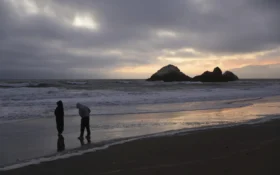
The tsunami reached the U.S. West Coast hours later, with waves measuring 1.6 feet above tide level observed in Arena Cove, California. Tsunami advisories remained in effect for California, Oregon, Washington, and large stretches of Alaska’s coastline. Multiple West Coast beaches were closed and residents were urged to stay away from the coast.
President Donald Trump urged residents in affected areas to pay attention to tsunami-related advisories. “STAY STRONG AND STAY SAFE!” Trump posted on social media.
The Philippines issued tsunami warnings for coastal areas facing the Pacific Ocean, with waves expected to arrive between 1:20 p.m. and 2:30 p.m. Wednesday afternoon. Philippine Institute of Volcanology and Seismology chief Teresito Bacolcol warned that “coastal areas in the Philippines fronting the Pacific Ocean are expected to be hit by tsunami of less than one meter.”
Tsunami alerts were also issued for Taiwan, Indonesia, Chile, Peru, Costa Rica, French Polynesia’s Marquesas Islands, Papua New Guinea, Solomon Islands, Vanuatu, and parts of Mexico and Central America. The Pacific Tsunami Warning Center warned of “hazardous tsunami waves” along coastlines throughout the Pacific Basin.
The earthquake struck along the Kuril-Kamchatka subduction zone, where the Pacific Plate slides beneath the Okhotsk Sea Plate. “This is a subduction zone setting that has the potential to generate large tsunamis,” Nathan Bangs, a research professor at the University of Texas Institute for Geophysics, told Al Jazeera. “It is similar to other settings that have generated large tsunamis in recent years that followed earthquakes, such as Sumatra in 2004 and Tohoku in 2011.”
Adding to the drama, Eurasia’s highest volcano erupted after the earthquake in the Kamchatka region. At 4,750 meters (15,580 feet), Klyuchevskaya Sopka is one of the world’s highest active volcanoes. Conditions on the volcano are often treacherous and unpredictable.
Dave Snider, tsunami warning coordinator with the National Tsunami Warning Center in Alaska, explained the ongoing danger: “A tsunami is not just one wave. It’s a series of powerful waves over a long period of time. Tsunamis cross the ocean at hundreds of miles an hour — as fast as a jet airplane — in deep water. But when they get close to the shore, they slow down and start to pile up.”
The earthquake occurred in one of the world’s most seismically active regions. The Kamchatka Peninsula and Japan both lie within the Pacific Ring of Fire, where earthquakes and volcanic eruptions are frequent. Earlier in July, five powerful quakes struck near Kamchatka, with the largest reaching magnitude 7.4.
Robert Weis, a tsunami expert at Virginia Tech, warned about the potential for serious damage.
“It is correct to be worried about this one,” Weis told Al Jazeera.
As of early Wednesday, many tsunami warnings had been lifted or downgraded to advisories, but authorities continued monitoring conditions and urged vigilance.