The United States has destroyed nearly 2,000 targets inside Iran in less than 100 hours, sunk more than 20 Iranian naval vessels, and silenced Iran’s missile attacks, which are down by 86% from the opening day of the conflict the commander of U.S. Central Command announced Wednesday.
Adm. Brad Cooper said a campaign dwarfs any American military operation in the Middle East in a generation.
“By order of the President of the United States and the Secretary of War, our military in the Middle East is undertaking an unprecedented operation to eliminate Iran’s ability to threaten Americans, as they’ve been doing for nearly half a century,” Cooper said.
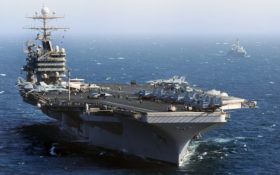
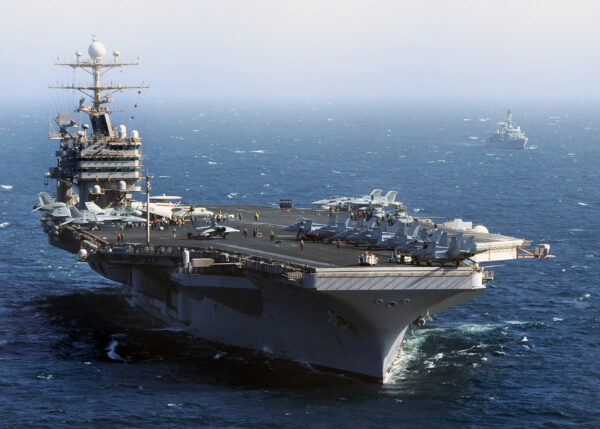
More than 50,000 American airmen, soldiers, and sailors with roughly 200 fighter aircraft, two aircraft carrier strike groups, and long-range bomber forces are now participating in Operation Epic Fury.
“These forces bring a massive amount of firepower, representing the largest buildup by the U.S. in the Middle East in a generation,” Cooper said.
He put the campaign’s opening phase in direct historical context. “Many of you may remember the shock and awe of the strikes of 2003. The first 24 hours of this operation were literally double the scale — and we continue with 24/7 strikes into Iran from seabed to space and cyberspace.”
B-2 and B-1 stealth bombers have carried out “uncontested surgical strikes” against missile production sites and launch facilities deep inside Iran. B-52 bombers have also entered the fight, striking Iran’s ballistic missile command-and-control positions — which signals the near-total collapse of Iranian air defenses, since the massive Cold War-era aircraft would not be able to attack against modern air defense network. The Army made history by firing Precision Strike Missiles — known as PrSMs — in combat for the first time, delivering long-range deep strikes against Iranian targets.
Take a look –
"100 Hours" of Operation Epic Fury. pic.twitter.com/XW5ZnRAJJL
— U.S. Central Command (@CENTCOM) March 4, 2026
Iran’s ability to fight back is deteriorating rapidly. Joint Chiefs Chairman Gen. Dan “Razin’” Caine confirmed Wednesday that Iranian ballistic missile launches are down 86% from the first day of fighting, with a 23% drop in just the last 24 hours.
“This progress has allowed CENTCOM to establish localized air superiority across the southern flank of the Iranian coast and penetrate their defenses with overwhelming precision and firepower,” Caine said.
Secretary of Defense Pete Hegseth said he was pleased with how well the campaign is going.
“I stand before you today with one unmistakable message about Operation Epic Fury — America is winning, decisively, devastatingly and without mercy,” Hegseth said. “The enemy can no longer shoot the volume of missiles they once did, not even close. Our air defenses and that of our allies have plenty of runway. We can sustain this fight easily for as long as we need to.”
“We are accelerating, not decelerating. Iran’s capabilities are evaporating by the hour while U.S. strength grows fiercer, smarter, and more dominant.”
CENTCOM is now pivoting to the next phase. Munitions will shift from stand-off munitions — such as Tomahawk cruise missiles — to stand-in weapons including GPS-guided bombs and Hellfire missiles for closer-range precision strikes as Iranian air defenses continue to collapse. CENTCOM forces are also actively hunting Iran’s remaining mobile ballistic missile launchers.
“Our military objectives are crystal clear,” Cooper said. “Our people are executing an immensely complex and historic mission with relentless lethality, conviction, and professionalism.”
Six American service members have been killed and ten seriously wounded since the operation began February 28.
Iran has launched more than 500 ballistic missiles and over 2,000 drones in retaliation across the region, targeting Israel, Gulf partners, and U.S. facilities in Saudi Arabia and the United Arab Emirates.