
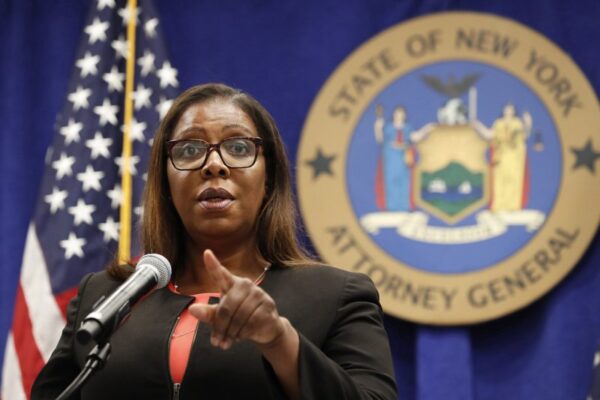
Controversial New York Attorney General Letitia James is leading a massive new, multistate Democratic lawsuit against the Trump administration.
James is targeting Trump’s tariff policies again, the second time she has sued the president on the issue. She is arguing that his replacement tariffs are just as illegal as the ones the Supreme Court struck down two weeks ago.
James filed the lawsuit on Thursday alongside 21 other Democratic attorneys general and the Democratic governors of Kentucky and Pennsylvania, targeting the 15% global import surcharge Trump imposed under the Trade Act of 1974 on February 20 — the same day the Supreme Court struck down his previous tariffs, which were enacted under the International Emergency Economic Powers Act.
“Once again, President Trump is ignoring the law and the Constitution to effectively raise taxes on consumers and small businesses,” James claimed.
“After the Supreme Court rejected his first attempt to impose sweeping tariffs, the president is causing more economic chaos and expecting Americans to foot the bill,” she said in her statement. “These tariffs will only drive up the cost of living, and I will continue to uphold the rule of law to protect New Yorkers.”
The huge Democratic coalition is demanding the court to declare the new tariffs unlawful and order the Trump administration to issue refunds to their states for tariff costs already paid.
The law allows a president to impose tariffs of up to 15% for 150 days to address a “large and serious” balance-of-payments deficit — which is distinct from a trade deficit, and instead tied to when the U.S. operated under the gold standard.
James and her Democratic allies claim those conditions do not exist today and that Trump’s own Justice Department said that trade deficits “are conceptually distinct from balance-of-payments deficits.”
Trump imposed the new tariffs within hours of the Supreme Court’s February 20 ruling, which struck down his previous tariffs 6-3.
Trump called the Supreme Court decision “deeply disappointing” and immediately moved to impose new tariffs, saying he would now go “over and above our normal tariffs already being charged.”
The White House has repeatedly defended the move, stating the president has the authority under the 1974 Trade Act’s Section 122 to address “fundamental international payment problems” and that the Supreme Court’s “disappointing decision will not deter the President’s effort to reshape the long-distorted global trading system.”
The tariffs are set to expire late July 2026 — 150 days after it took effect — unless Congress votes to extend it. The White House has also announced plans to impose other tariffs under Section 301 of the Trade Act of 1974, which first needs an investigation by the U.S. Trade Representative before it can be implimented.