
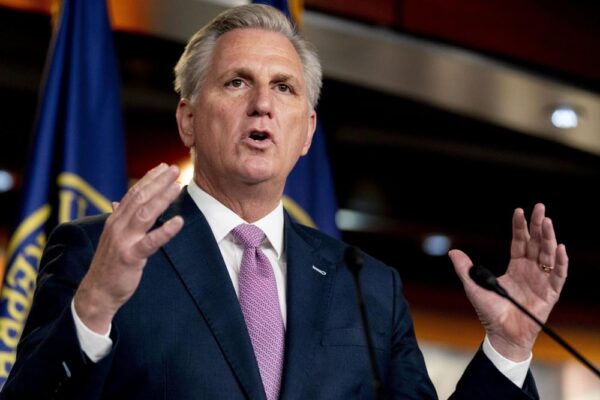
Longtime top Republican Kevin McCarthy won the nomination Tuesday for House speaker, clearing an important step with majority support from his colleagues.
But it’s not over yet. McCarthy now faces a weeks-long slog to quell conservative lawmaker objections before a final vote in the new year.
McCarthy has led House Republicans for years. With the party now set to win back majority control, he would seize the gavel from Nancy Pelosi.
The establishment GOP leader easily pushed through the internal party election on a 188-31 vote, with secret ballots cast by new and returning lawmakers, but there remain challenges ahead.
McCarthy will need to grind out support from no fewer than 218 lawmakers from his slim majority when the new Congress convenes in January, leaving just a few votes to spare.
“We’ve got our work cut out for us,” McCarthy said, his voice strained after the vote.
The Californian noted that past speakers fell short in initial voting only to eventually claim the gavel, and he has highlighted backing from former President Donald Trump and his MAGA Republican faithful like Rep. Marjorie Taylor Greene of Georgia and Rep. Jim Jordan of Ohio.
“Either we’re going to lead as a team or we’re going to lose as individuals,” he said.
But Republican leaders are facing an intense backlash from conservative voters over their disappointing performance in the midterm elections, when McCarthy’s promises of a GOP sweep that would transform Washington collapsed. Instead, the House could have one of the slimmest majorities in 90 years, leaving McCarthy exposed to challengers and risking his ability to govern.
On Wednesday, fellow Republican establishment leader Mitch McConnell fended off a challenge from Rick Scott of Florida, the party’s campaign chairman, in an election to lead the U.S. Senate.
The former chairman of the conservative House Freedom Caucus, Rep. Andy Biggs of Arizona, challenged McCarthy but fell short. He still insisted that his speakership “should not be a foregone conclusion” and said five votes went to neither candidate, an indication of broader opposition to McCarthy.
It’s not just McCarthy whose leadership was in question. Fellow establishment GOP Rep. Tom Emmer, R-Minn., the campaign chairman who traditionally would be rewarded with a leadership spot, ended up slugging it out in a three-way race for the GOP’s whip job, defeating Trump ally Rep. Jim Banks, R-Ind., after a second-round of voting.
The No. 2 Republican, Rep. Steve Scalise of Louisiana, had an easier time, winning the majority leader spot uncontested, by voice vote. Also unopposed, Rep. Richard Hudson, of North Carolina, will lead the campaign arm, the National Republican Congressional Committee.
And one of Trump’s top allies in the House, Rep. Elise Stefanik of New York — the party’s conference chairwoman and the first lawmaker to back Trump in a 2024 run — fended off rival Rep. Byron Donalds of Florida in a race that was closer than expected.
A self-described “Trump-supporting, liberty-loving, pro-life, pro-Second Amendment Black man,” Donalds is seen by many as a potential new party leader.
Trump backed McCarthy for speaker, but the two have had a rocky relationship, and even Trump’s support is no guarantee McCarthy will reach the needed 218 votes when the new Congress convenes, particularly if Republicans win the House with just a slim, few-seat majority that would leave him no cushion for detractors.
One Trump ally, Rep. Matt Gaetz of Florida, opposes McCarthy and predicted he will fall short, as happened in an earlier bid.
“To believe that Kevin is going to be speaker, you have to believe that he’s going to move votes in the next six weeks that he couldn’t move in the last six years,” Gaetz said.
But saying she’s “proud” of McCarthy for listening to all lawmakers, Greene said “it’s so important for us to stay unified and get behind him as our speaker.”
The weeks ahead promise to be a grueling period of hardball negotiations with the Freedom Caucus and rank-and-file Republicans as McCarthy tries to appease them and rack up the support he will need in the new year.
The conservative Freedom Caucus lawmakers, who typically align with Trump, are prepared to extract demanding concessions from McCarthy before giving him their backing. They have a long list of asks — from prime positions on House committees to guarantees they can have a role in shaping legislation.
“I’m willing to support anybody that’s willing to change dramatically how things are done here,” Rep. Scott Perry, R-Pa., the chairman of the Freedom Caucus and a Trump ally, said after meeting privately Monday with McCarthy.
Democrats will hold their party elections after Thanksgiving, as Pelosi and the top two leaders, Reps. Steny Hoyer and Jim Clyburn, decide whether to stay on or step aside for a new generation eager to take over.
Pelosi could very well join the new Congress in January, declining to run for leadership, having won reelection for another two-year term representing San Francisco.
That’s a route Clyburn, of South Carolina, indicated he would take if Democrats lost majority control.
“I’ve told everybody that I have no interest at this particular juncture of my life to run for speaker of the House or to run for minority leader of the House,” Clyburn told reporters. “I do wish to remain at the leadership table. As to what capacity that will be, I will leave that up to our Democratic caucus.”
The Associated Press contributed to this article