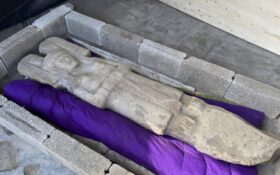
Farmers digging in a citrus grove near Mexico’s Gulf coast have found a striking, six-foot-tall statue of a female figure who may represent an elite woman rather than a goddess, or some mixture of the two, experts said Friday.
The National Institute of Anthropology and History said it was the first such statue found in a region known as the Huasteca.
The carved woman has an elaborate hairpiece and marks of status, and may date to around 1450 to 1521, the institute said. While the site where it was found is nearer to the pre-Hispanic ruin site of El Tajín, the statue shows some influences of the Aztecs.
Farmers digging in the grove found it on New Year’s Day and quickly reported it to authorities. The area where it was found was not previously known to be an archeological site, and the stone statue may have been moved from some unknown original site.
Just who the open-mouthed, wide-eyed statue depicts remains something of a mystery.
Institute archaeologist María Eugenia Maldonado Vite wrote that “this could be a ruler, based on her posture and attire, more than a goddess.”
Maldonado added it could be “a late fusion between the Teem goddesses and women of high political or social status in the Huasteca.” Those goddesses were part of a fertility cult.
Susan Gillespie, an anthropology professor at the University of Florida, said there “there are quite a few pre-Hispanic depictions of elite women and female rulers elsewhere, best known among the Classic Maya but also in Classic Zapotec bas-reliefs and Postclassic Mixtec codices.”
“Colonial era Aztec documents mentioned women ‘rulers’ or at least holders of the crown to pass on to their successors … so that is not a surprise,” Gillespie added. “Women were highly valued in the pre-Hispanic era, drastically losing their status only after the conquest.”
However, she noted that “if there is only one such find, it’s hard to say whether it is significant, or even correctly identified. Archaeology works best with repeated occurrences, to show a pattern.”
In 1994 in the Mayan ruin site of Palenque, archaeologists found the tomb of a woman dubbed The Red Queen because of the red pigment covering her tomb. But it has never been firmly established that the woman, whose tomb dates from between 600 and 700 A.D., was a ruler of Palenque.
The Associated Press contributed to this article