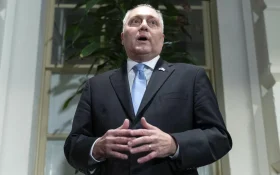
Paralyzed by infighting, some Republican Party moderate leaders have quietly reached out to Democrats in the House to help them elect the next speaker — and blasted conservatives that refused to support Rep. Steve Scalise’s bid as “traitors.”
Armed Services Chairman Mike Rogers, R-Ala., and Foreign Affairs Chairman Michael McCaul, R-T.X., both acknowledged they were unable to secure the 127 votes to elect Scalise speaker.
Rodgers said he was asking Democrats for help to overcome conservative holdouts.
“They put us in this ditch along with eight traitors,” Rodgers said about the ousting of Speaker Kevin McCarthy last week. “We’re still the majority party, we’re willing to work with them, but they gotta tell us what they need.”
McCaul told Bloomberg they’re also considering enhancing the powers of the temporary acting Speaker of the House, Patrick McHenry, to secure an aid package for Israel — which would also require Democratic support.
“I don’t think we’re gonna have any other option,” McCaul said about the urgency for national security aid to the Israelis.
Next steps are uncertain as the House is essentially closed while the Republican majority tries to elect a speaker.
“I just shared with my colleagues that I’m withdrawing my name as a candidate for speaker-designee,” Scalise, the House majority leader, said late Thursday as he emerged from the closed-door meeting at the Capitol.
Scalise, R-La., said the Republican majority still has to come together and “open up the House again. But clearly not everybody is there.”
He had been working furiously to secure the votes after being nominated by a majority of his colleagues, but after hours of private meetings over two days and late into the evening it was clear many other Republican lawmakers were not budging from their refusal to support him.
Asked if he would throw his support behind conservative Rep. Jim Jordan, Scalise said, “It’s got to be people that aren’t doing it for themselves and their own personal interest.”
The hold-outs argued that as majority leader, Scalise was no better choice than McCarthy, that he should be focusing on his health as he battles cancer and that he was not the leader they would support. The House closed late in the night, with lawmakers vowing to meet again early Friday.
“We will come together and we will move forward for the good of the country,” Jordan said afterward.
Attention now focuses on Jordan. His backers, including former President Donald Trump, instantly revived calls for party members to get behind the Ohio Republican, who is a founding leader of the hard-right House Freedom Caucus.
“Make him the speaker. Do it tonight,” said Rep. Jim Banks, R-Ind. “He’s the only one who can unite our party.”
But Jordan has a long list of establishment detractors who started making their opposition known. Other potential speaker choices were also being floated.
Democrats have relished in the infighting and said they’re willing to make a power sharing deal with moderate Republicans.
“The House Democrats have continued to make clear that we are ready, willing, and able to find a bipartisan path forward,” minority leader Hakim Jefferies said about a potential alliance. “But we need traditional Republicans to break from the extremists and partner with us.”
The Horn editorial team and the Associated Press contributed to this article